

Prostate Health After 50: The Complete Guide
Reading time: ~12 minutes | Medically referenced | Last updated July 2026
Medical Disclaimer: This article is for educational purposes only and does not substitute professional medical advice, diagnosis, or treatment. Prostate symptoms and lab values must always be interpreted by a licensed physician or urologist who knows your personal and family history. If you notice new urinary, sexual, or pelvic symptoms, schedule an appointment rather than relying on internet research — including this article.

Turning 50 changes a man’s relationship with his prostate whether he wants it to or not. It’s not dramatic — usually it’s a slightly weaker stream, a 2 a.m. trip to the bathroom, or a PSA number on a lab report that suddenly matters. But the numbers behind that shift are bigger than most men realize: roughly 45% of men over 45 develop benign prostatic hyperplasia (BPH), and that climbs to about 80% in men over 70. Prostate cancer, meanwhile, is projected to account for about 333,830 new U.S. diagnoses in 2026 — making it, other than skin cancer, the most common cancer in American men.
This guide walks through what actually happens to the prostate after 50, what the lab numbers mean, what’s normal aging versus a warning sign, and what the evidence actually supports for prevention — not marketing claims, but numbers from urology journals, the American Cancer Society, and the National Cancer Institute’s SEER program.
Table of Contents
- What Happens to the Prostate After 50
- PSA Levels by Age: The Real Reference Ranges
- BPH (Enlarged Prostate): The Numbers Behind the Symptoms
- Prostate Cancer After 50: Risk in Context
- Warning Signs You Shouldn’t Ignore
- Screening Guidelines: When to Actually Get Tested
- What the Evidence Says About Diet
- Exercise and the Prostate: What the Research Shows
- Supplements: What to Know Before You Buy
- A Realistic Monthly Self-Check Routine
- FAQ
What Happens to the Prostate After 50 {#what-happens}
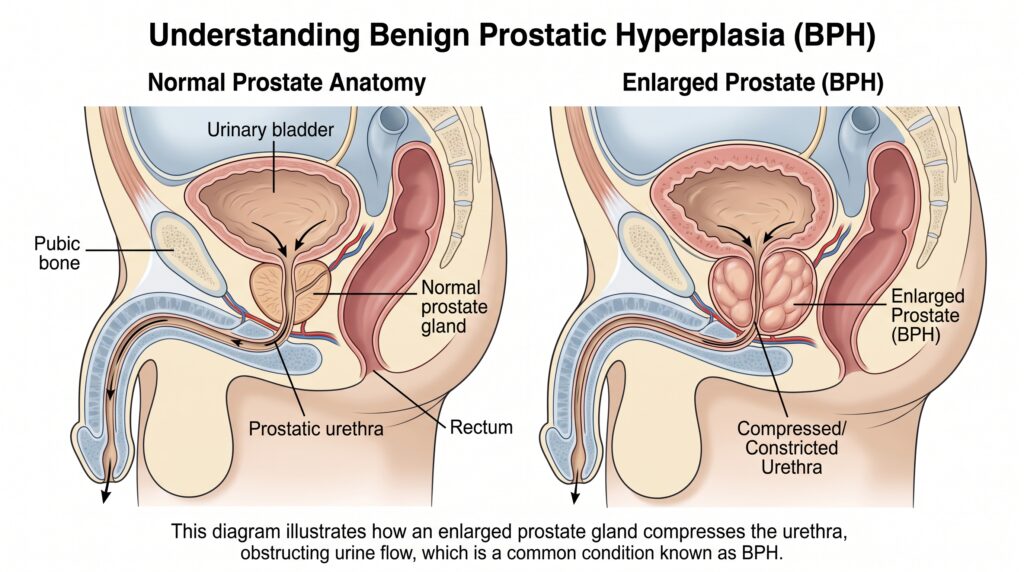
The prostate is a walnut-sized gland that sits just below the bladder, wrapped around the urethra. It stays roughly the same size through a man’s 20s and 30s, but starting around midlife it tends to keep growing for the rest of his life — a process driven mostly by hormonal shifts in testosterone and dihydrotestosterone (DHT) metabolism, not anything a man did “wrong.”
That slow enlargement is why lower urinary tract symptoms (LUTS) — hesitancy, weak stream, incomplete emptying, nighttime urination (nocturia) — become so common with age. It’s also why two separate but related conditions dominate this decade of a man’s health: BPH, a benign structural change, and prostate cancer, a cellular one. They can coexist, and having one doesn’t cause the other, but both get more likely with every passing year.
PSA Levels by Age: The Real Reference Ranges {#psa-ranges}
Prostate-specific antigen (PSA) is a protein made by both normal and cancerous prostate tissue. A single “normal” cutoff of 4.0 ng/mL used to be applied to every man, but urology has moved toward age-specific reference ranges because PSA naturally rises as men age, largely because the prostate itself grows larger.
Widely cited age-adjusted reference ranges (values below which most men are considered low-risk) look like this:
| Age Range | Typical Upper Limit of Normal PSA | Notes |
|---|---|---|
| 40–49 years | 0–2.5 ng/mL | Average PSA in this age group is often only 0.5–0.7 ng/mL |
| 50–59 years | 0–3.5 ng/mL | Gradual prostate growth begins to raise baseline PSA |
| 60–69 years | 0–4.5 ng/mL | A score above 4.0 ng/mL is generally flagged as abnormal for this age |
| 70–79 years | 0–6.5 ng/mL | Ranges widen further, reflecting normal age-related prostate growth |
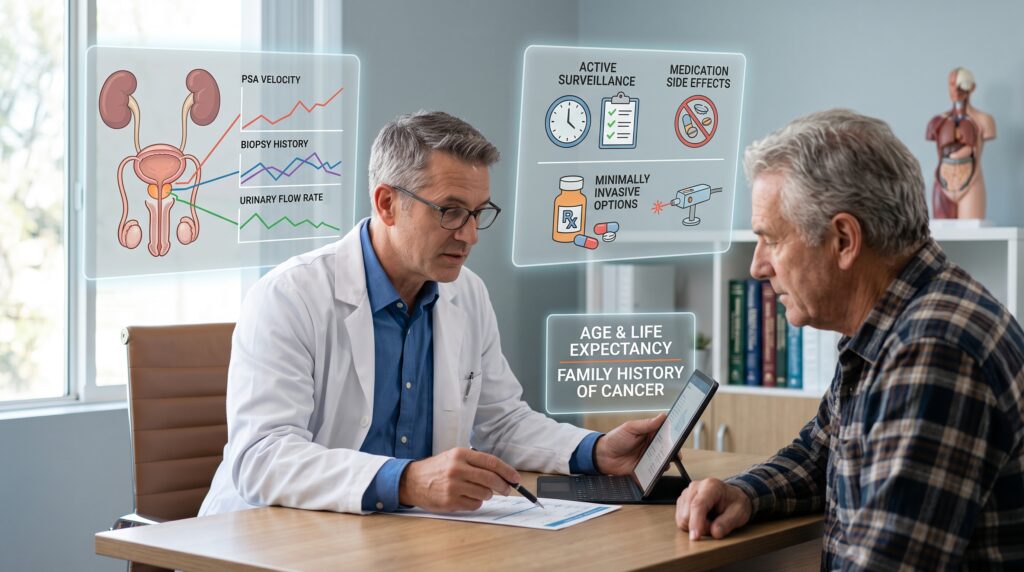
- PSA velocity matters as much as the number itself. A rise of more than about 0.35 ng/mL within a single year can prompt further testing even if the absolute number is still “in range.”
- PSA between 4 and 10 ng/mL is a gray zone. Values in this range are associated with roughly a 25% chance of prostate cancer, with BPH, prostatitis, or a recent urinary tract infection accounting for many of the rest.
- Above 10 ng/mL raises the odds substantially. A PSA over 10 ng/mL is linked to roughly a 50% probability of prostate cancer, which is why doctors typically escalate to imaging or biopsy at that point.
- PSA is not cancer-specific. Prostatitis, recent catheterization, prostate biopsy, and even vigorous cycling or ejaculation shortly before testing can temporarily elevate it.
Practical takeaway: A single PSA number, in isolation, tells you very little. Trends over 2–3 tests, combined with a digital rectal exam and your personal risk factors, tell a urologist far more than one lab value ever could.
BPH (Enlarged Prostate): The Numbers Behind the Symptoms {#bph}
Benign prostatic hyperplasia is, statistically, the default state of an aging prostate rather than the exception:
- Autopsy studies show BPH present in 50–60% of men in their 60s, rising to 80–90% of men over 70.
- Clinical prevalence of BPH in men over 50 is estimated at 50–75% depending on the population studied.
- Globally, BPH prevalent cases rose from about 50.7 million in 1990 to 112.5 million in 2021 — largely a reflection of longer life expectancy.
- Obesity meaningfully raises individual risk: men with obesity have roughly 3.5 times the risk of BPH compared with normal-weight men.
BPH itself is not cancer and does not “turn into” cancer, but the two can occur in the same gland at the same time, which is one reason symptoms shouldn’t be self-diagnosed as “just BPH” without a professional exam.
Prostate Cancer After 50: Risk in Context {#cancer-risk}
Numbers here are worth sitting with, because they cut both ways — real risk, but also a strong survival story:
- The American Cancer Society estimates about 333,830 new prostate cancer cases and 36,320 deaths in the U.S. for 2026.
- Prostate cancer represents about 15.8% of all new U.S. cancer cases, and roughly 1 in 8 men will be diagnosed in their lifetime.
- About 6 in 10 cases occur in men 65 or older, and the average age at diagnosis is around 67; it is rare before age 40.
- The overall five-year relative survival rate is now roughly 98%, a figure driven largely by early detection — most men are diagnosed while the disease is still localized.
- Risk is not distributed equally: Black men have the highest prostate cancer incidence of any racial group in the data, at roughly 191.5 cases per 100,000 — about 67% higher than the rate in white men, and mortality disparities are similarly pronounced.
- Family history matters concretely: having one first-degree relative with prostate cancer, or two extended family members, can move up the recommended screening start age to 40–54.
For a deeper look at how to tell ordinary aging symptoms apart from something that needs urgent attention, see our detailed breakdown: Prostate Warning Signs After 50: What’s Normal, What’s Not, and When to Act.
Warning Signs You Shouldn’t Ignore {#warning-signs}
Most prostate changes are gradual and benign, but a short list of symptoms should prompt a same-week (not “someday”) doctor’s visit:
- Blood in urine or semen (hematuria/hematospermia)
- New, unexplained pain in the lower back, hips, or pelvis
- Sudden inability to urinate (acute urinary retention) — this is an emergency
- Unintentional weight loss combined with urinary changes
- Erectile changes that appear suddenly, alongside urinary symptoms
- A PSA rise flagged by your doctor as faster than expected for your age
None of these guarantee cancer — infections, stones, and BPH cause several of them too — but they’re the symptoms clinicians say patients wait too long to report. For a full symptom-by-symptom breakdown of what’s ordinary aging versus what needs urgent evaluation, read: Prostate Warning Signs After 50: What’s Normal, What’s Not, and When to Act.
Screening Guidelines: When to Actually Get Tested {#screening}
Screening recommendations have shifted more than once in the past two decades, which understandably confuses patients:
- The U.S. Preventive Services Task Force currently recommends individualized, informed decision-making about PSA screening for average-risk men aged 55–69, rather than blanket screening or blanket avoidance.
- General screening is typically recommended starting at 55 for average-risk men.
- Black men and men with a strong family history are generally advised to begin earlier, often around age 45, given their measurably higher incidence and mortality.
- Routine PSA screening is generally not recommended past age 70, since competing health risks usually outweigh the benefit of catching a slow-growing cancer at that stage — though this is always an individualized conversation, not a hard rule.
The conversation to have with your primary care doctor or urologist isn’t “should I get a PSA test, yes or no” — it’s “given my age, race, and family history, what’s my personal screening schedule.”
What the Evidence Says About Diet {#diet}
Diet research on the prostate is genuinely mixed — much weaker than the exercise evidence — but a few patterns show up consistently across nutrition and urology literature:
- Diets high in processed red meat and saturated fat are associated with higher BPH and prostate cancer risk in observational studies, though causation is harder to prove than for exercise.
- Tomatoes and other lycopene-rich foods, cruciferous vegetables (broccoli, cauliflower), and fatty fish are the foods most consistently mentioned in urology dietary guidance, though large randomized trials proving cancer prevention are still limited.
- Obesity is one of the more robust dietary-adjacent risk factors: as noted above, obesity roughly triples BPH risk compared with a normal weight, likely through hormonal and inflammatory pathways.
Because diet evidence for prostate outcomes specifically is still evolving, most urologists frame it as “follow general cardiovascular-healthy eating patterns” rather than prescribing a rigid prostate-specific diet.
Exercise and the Prostate: What the Research Shows {#exercise}
This is the area with the strongest, most consistent data of any prostate lifestyle factor:
- A pooled analysis found men engaging in moderate to heavy physical activity had roughly 25–26% lower odds of BPH or LUTS compared with sedentary men (odds ratios of 0.74 in both groups).
- Higher leisure-time physical activity was linked to a 52% reduced risk of LUTS in one analysis, with no clear extra benefit from very high intensity — meaning moderate, consistent activity may be enough.
- Even brisk walking helps: an additional three hours of walking per week was linked to about a 10% further reduction in BPH-related risk.
- Among men with newly developed BPH, being active just one or more hours per week was associated with 13% lower odds of nocturia and 34% lower odds of severe nocturia compared with inactive men.
- Proposed mechanisms include reduced sympathetic nervous system activity, more favorable testosterone and insulin profiles, and lower chronic inflammation and oxidative stress — not just “burning calories.”

If you want a structured, urologist-informed routine rather than generic “just move more” advice, our companion article breaks down specific movements by category (pelvic floor, aerobic, strength) and explains the reasoning behind each: The Best Exercises for Prostate Health: What Urologists Actually Recommend.
Supplements: What to Know Before You Buy {#supplements}
The supplement aisle for prostate health is enormous, and the quality of the evidence behind individual products varies enormously too. Ingredients like saw palmetto, beta-sitosterol, pygeum, and pumpkin seed extract show up repeatedly in small trials with mixed results — some show modest symptom improvement in mild-to-moderate BPH, others show no significant difference from placebo. None of them are a substitute for a urologist’s evaluation, and none should be started without telling your doctor, especially if you’re already on medication for BPH or blood pressure.
If you’re researching a specific product, it’s worth reading independent breakdowns of ingredients, dosages, and real user feedback rather than relying only on manufacturer marketing. For example, our team has published a detailed, independent look at one popular option here: ProstaVive Review 2026: Ingredients, Benefits, Side Effects, and Real Customer Experiences.
A Realistic Monthly Self-Check Routine {#self-check}
There’s no reliable at-home physical self-exam for the prostate (unlike, say, a testicular or skin self-check) — the gland can only be properly assessed by a clinician. What men can usefully track at home is a simple symptom log:
- How many times you wake to urinate at night (nocturia count)
- Whether your stream feels weaker or more hesitant than six months ago
- Any pain during urination or ejaculation
- Any blood in urine or semen
- Your last PSA number and the date it was drawn
Bringing this log to an annual physical gives your doctor real trend data instead of a vague “I think it’s been worse lately.”
Illustrative example: James, a hypothetical 54-year-old, started tracking nighttime bathroom trips after noticing he was up three times a night instead of his usual one. Six weeks of tracking showed a clear upward trend, which he brought to his primary care doctor — leading to a PSA test and an uncomplicated BPH diagnosis managed with medication. This is a composite scenario for illustration, not an individual patient case.
FAQ {#faq}
Is it normal for PSA to rise every year after 50? Some gradual rise is expected as the prostate naturally grows with age. A rise faster than about 0.35 ng/mL per year is what tends to prompt closer monitoring, not the rise itself.
Does an enlarged prostate mean I’ll get prostate cancer? No. BPH and prostate cancer are different processes and one does not cause the other, though both become more common with age and can technically coexist in the same gland.
At what age should I get my first PSA test? Generally 55 for average-risk men, but earlier — often 45 — for Black men or those with a strong family history. Discuss your personal timeline with your doctor.
Can exercise alone prevent BPH? It can meaningfully lower risk and ease symptoms — studies show up to a roughly 50% reduced risk of LUTS with higher activity levels — but it isn’t a guarantee, and existing symptoms should still be evaluated medically.
Are prostate supplements a substitute for medical treatment? No. At best, some may provide modest symptom relief in mild cases; they should be discussed with a doctor before use and never replace diagnosis or prescribed treatment.
Sources
- American Cancer Society — Key Statistics for Prostate Cancer
- National Cancer Institute SEER — Cancer Stat Facts: Prostate Cancer
- Johns Hopkins Medicine — Prostate Cancer: Age-Specific Screening Guidelines
- Prostate Cancer Foundation — Interpreting Your PSA Level
- NCBI StatPearls — Benign Prostatic Hyperplasia
- Harvard Health Publishing — Exercise and Benign Prostatic Hyperplasia (BPH)
- ScienceDirect / European Urology — Physical Activity, Benign Prostatic Hyperplasia, and Lower Urinary Tract Symptoms
- PMC — Modulating Benign Prostatic Hyperplasia Through Physical Activity
This article is regularly reviewed against current American Cancer Society, NCI, and peer-reviewed urology literature. It is not a substitute for professional medical advice — always consult a licensed physician or urologist about your individual symptoms, lab results, and treatment options.
Related reading:
- ProstaVive Review 2026: Ingredients, Benefits, Side Effects, and Real Customer Experiences
- The Best Exercises for Prostate Health: What Urologists Actually Recommend
- Prostate Warning Signs After 50: What’s Normal, What’s Not, and When to Act
Tags: #ProstateHealth #MensHealthAfter50 #BPH #PSALevels #ProstateCancerAwareness #UrologyTips #HealthyAgingMen #PreventiveHealth
5 thoughts on “Prostate Health After 50: The Complete Guide”