

Enlarged Prostate (BPH): Symptoms to Watch
Medical disclaimer: This article is for educational purposes only and does not substitute professional medical advice, diagnosis, or treatment. Always consult a licensed urologist or physician about your specific symptoms before making any health decision.
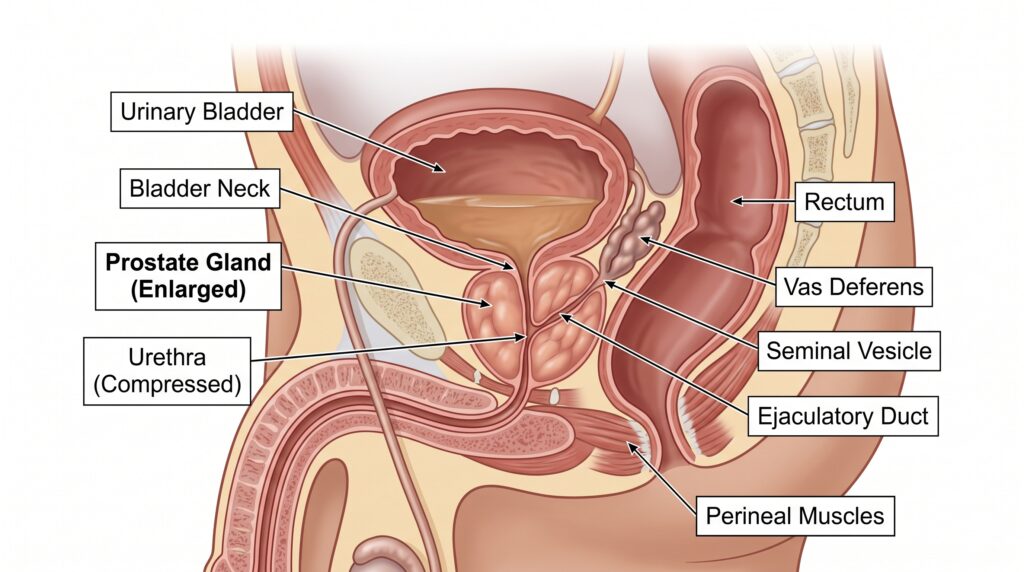
If you’ve started getting up two or three times a night to urinate, or you’ve noticed your stream isn’t quite what it used to be, you’re not imagining it — and you’re far from alone. Benign prostatic hyperplasia (BPH), commonly called an enlarged prostate, is one of the most common conditions in aging men. It isn’t cancer, and in most cases it isn’t dangerous on its own — but ignoring the early signs can lead to complications that are entirely avoidable with the right care at the right time.
This guide walks through the specific symptoms to watch for, the numbers doctors actually use to grade severity, when a symptom crosses the line from “annoying” to “get checked now,” and what real diagnostic ranges look like — all sourced from peer-reviewed research and major health authorities.
How Common Is an Enlarged Prostate, Really?
BPH is often treated like a minor inconvenience, but the epidemiology tells a bigger story. Autopsy studies cited by the National Institutes of Health show that the histologic prevalence of BPH is approximately 10% for men in their 30s, 20% for men in their 40s, reaches 50% to 60% for men in their 60s, and is 80% to 90% for men in their 70s and 80s. In other words, if you live long enough, some degree of prostate enlargement is nearly universal.
The numbers get more striking when you look at symptom severity rather than just tissue growth. Patent literature summarizing clinical data notes that 27% of men in the 60–70 age bracket have moderate-to-severe symptoms, and 37% of men in their 70s suffer from moderate-to-severe symptoms. And it’s not just an “older man’s problem” in the way people assume — global burden-of-disease researchers estimate that approximately 45% of men over 45 develop BPH, with prevalence rising to about 80% in men over 70, and that worldwide case numbers more than doubled between 1990 and 2021, from roughly 50.7 million to 112.5 million prevalent cases.
Why the surge? Longer life expectancy plays a role, but so does something less obvious: recent research points to a strong relationship between clinical BPH, metabolic syndrome, and erectile dysfunction, along with a possible role for chronic inflammation in driving prostatic hyperplasia. This is part of why urologists increasingly ask about waist circumference, blood sugar, and cardiovascular health during a BPH workup — the prostate doesn’t grow in isolation from the rest of the body.
The Two Symptom Categories: Storage vs. Voiding
Doctors don’t just lump BPH symptoms together — they split them into two functional groups, and knowing the difference actually helps you describe what’s happening more precisely to your doctor.
Voiding (obstructive) symptoms — trouble getting urine out
- A weak or interrupted urine stream
- Straining or pushing to start urination
- A feeling that the bladder never fully empties
- Dribbling at the end of urination
- Starting and stopping mid-stream (intermittency)
Storage (irritative) symptoms — trouble holding urine in
- Urgency — a sudden, hard-to-postpone need to urinate
- Frequency — needing to go more than eight times in 24 hours
- Nocturia — waking up two or more times a night to urinate
- Occasional urge incontinence
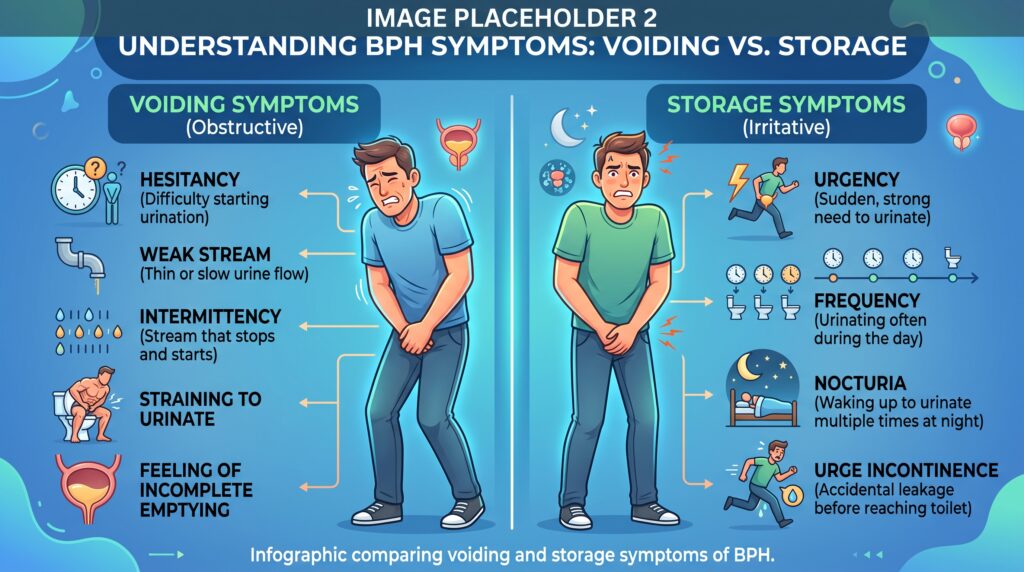
Most men experience a blend of both categories, and the mix tends to shift over time — early BPH often shows up as mild frequency, while more advanced obstruction brings in the weak stream and incomplete emptying.
The Number Doctors Actually Use: IPSS
If you’ve ever filled out a short questionnaire in a urology waiting room asking things like “how often did you have a sensation of not emptying your bladder completely,” that’s the International Prostate Symptom Score (IPSS) — a validated 7-question tool that turns subjective symptoms into an objective number.
Here’s how the scoring breaks down, each question rated 0–5, for a total possible score of 0–35:
| IPSS Total Score | Severity | Typical Approach |
|---|---|---|
| 0–7 | Mild | Watchful waiting, especially if minimally bothered |
| 8–19 | Moderate | Alpha-blockers or combination therapy, especially with prostate volume above 40 mL |
| 20–35 | Severe | Further objective testing before considering surgical options |
A score in isolation isn’t the whole picture, though. Research on IPSS interpretation cautions that the score alone is insufficient to determine surgical eligibility — roughly 25% of patients selected by IPSS criteria alone experience symptom worsening after surgery, which is exactly why urologists pair it with uroflowmetry, post-void residual volume, and sometimes ultrasound before recommending a procedure.
If you want to get a rough sense of where you might fall, the American Urological Association’s symptom index (functionally identical to the IPSS) is worth doing honestly and bringing to your appointment — it turns a vague “I’ve been going to the bathroom a lot” into data your doctor can actually act on.
PSA and BPH: What the Numbers Mean (and Don’t Mean)
A PSA (prostate-specific antigen) blood test often gets ordered alongside a BPH workup, and it causes a lot of unnecessary anxiety because people assume any elevation means cancer. It doesn’t — BPH itself raises PSA, since a larger gland simply produces more of the protein.
Reference ranges commonly used in age-specific PSA screening:
| Age Range | Upper Limit of “Normal” PSA |
|---|---|
| 40–49 years | ≤ 2.5 ng/mL |
| 50–59 years | ≤ 3.5 ng/mL |
| 60–69 years | ≤ 4.5 ng/mL |
| 70–79 years | ≤ 6.5 ng/mL |
These age-adjusted figures are drawn from thresholds cited by multiple clinical sources, representing the upper limit of the normal range for each age group. Levels in the 4–10 ng/mL “gray zone” don’t automatically mean cancer either — that range might suggest the possibility of prostate cancer in roughly 25% of cases, or it might simply reflect BPH, which is why doctors often order a free-PSA-to-total-PSA ratio to help decide whether a biopsy is warranted, rather than reacting to a single number.
The takeaway: an elevated PSA is a prompt for further evaluation, not a diagnosis. Don’t panic over one blood draw — trend, context, and a proper clinical exam matter more than a single value.
Red-Flag Symptoms: When BPH Stops Being “Just Annoying”
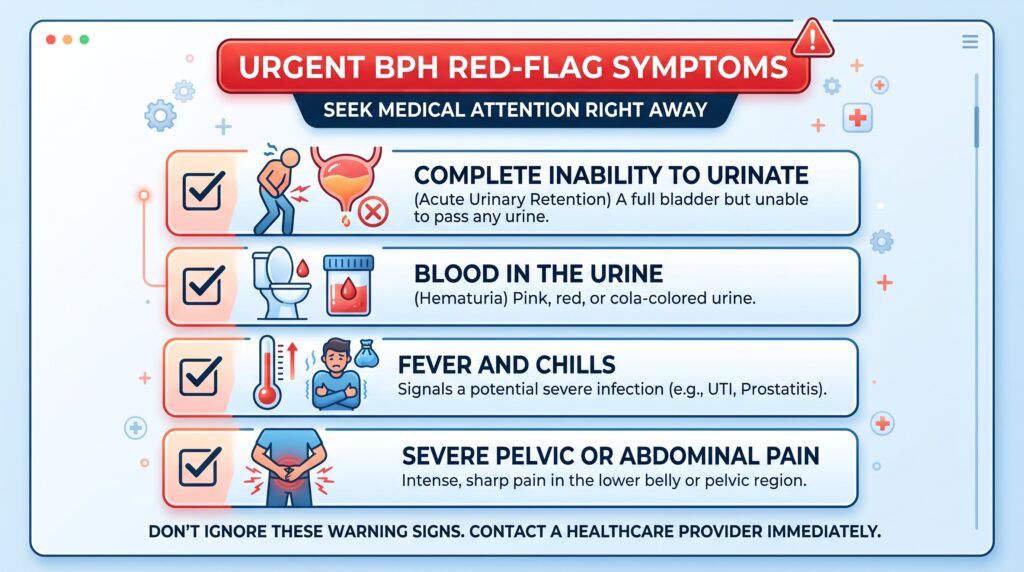
Most BPH symptoms build gradually and are more of a quality-of-life issue than an emergency. But a few signs mean you should stop waiting for your next scheduled check-up and get seen right away:
- Complete inability to urinate (acute urinary retention) — this is a medical emergency
- Blood in the urine (visible or picked up on a urine test)
- Fever, chills, or pain with urination — could indicate a urinary tract infection or prostatitis rather than simple BPH
- Pain in the lower back, hips, or pelvis that doesn’t resolve
- Unintentional weight loss alongside urinary symptoms
Acute retention isn’t as rare as people assume once BPH has been present for years. A large population study out of Olmsted County, Minnesota found that the incidence of urinary retention increased more than tenfold with age — from about 3 per 1,000 men aged 40–49 to 34.7 per 1,000 men aged 70–79. That climbing curve is precisely why untreated, progressively worsening symptoms deserve medical attention rather than years of “I’ll just deal with it.”
A Composite Patient Scenario (For Illustration Only)
To make this concrete: consider a hypothetical, composite case built from common clinical patterns — not a specific real patient, and not medical guidance for your situation. A 63-year-old man notices he’s waking up twice a night to urinate, something that started subtly over about 18 months. He assumes it’s just “getting older” until his stream noticeably weakens and he starts feeling like he never fully empties his bladder. When he finally brings it up at a routine physical, his IPSS questionnaire comes back at 14 — solidly in the moderate range — and his PSA is 2.1 ng/mL, within the normal range for his age. His doctor starts him on an alpha-blocker and schedules a follow-up in six weeks.
This pattern — slow onset, normalized as “just aging,” followed by a moderate IPSS score once finally assessed — is extremely common in clinical practice, which is exactly why proactive screening conversations (rather than waiting for symptoms to become severe) tend to lead to better outcomes.
Risk Factors Worth Knowing
- Age — the single strongest predictor; prevalence of LUTS ranges from 44% in men aged 40–59 to 70% in older groups
- Family history — heritable BPH is associated with larger prostate volume and earlier onset
- Metabolic syndrome and obesity — increasingly linked to BPH severity
- Ethnicity — some studies suggest lower risk among Asian populations compared with Western white populations, though genetics, diet, and lifestyle likely all play a role
FAQ: Quick Answers to Common Questions
Is an enlarged prostate the same as prostate cancer? No. BPH is a non-cancerous, age-related enlargement of the gland. However, both conditions can raise PSA and share some symptoms, which is why proper evaluation matters — one doesn’t rule out the other.
Can BPH symptoms come and go? Yes, to a degree. Symptoms often fluctuate with hydration, caffeine or alcohol intake, cold medications (many decongestants worsen urinary retention), and even stress. But a true worsening trend over months should be evaluated, not just monitored indefinitely on your own.
Do lifestyle changes actually help? Evidence suggests they can. Reducing evening fluid intake, moderating caffeine and alcohol, and staying physically active are associated with better symptom control, and researchers increasingly view diet, exercise, and inflammation as relevant modifiable factors in BPH severity.
At what age should I start paying attention to this? Given that histologic BPH prevalence is already around 20% in men in their 40s, it’s reasonable to start tracking urinary symptoms and discussing them at annual physicals from your mid-40s onward, especially with a family history.
Where to Go From Here
Understanding your symptoms is the first step — building a broader plan for long-term prostate health is the next one. These guides go deeper into prevention, natural support strategies, and product comparisons:
- Prostate Health After 50: The Complete Guide
- Prostate Health After 50: The Complete Guide (Part 2)
- Prosta Peak: The Complete Guide to Natural Prostate Support in 2026
- Best Prostate Supplements in 2026: Ingredients That Actually Work
Sources & Further Reading
This article draws on peer-reviewed research and major health authorities, including:
- Benign Prostatic Hyperplasia: An Overview — PMC / NIH
- Benign Prostatic Hyperplasia — StatPearls, NCBI Bookshelf
- Epidemiology of Clinical Benign Prostatic Hyperplasia — PMC
- Comprehensive Analysis of the Global Burden of BPH, 1990–2021 — Scientific Reports / Nature
- The Rising Worldwide Impact of Benign Prostatic Hyperplasia — PMC
- International Prostate Symptom Score (IPSS) Interpretation — droracle.ai
- Mayo Clinic — Benign Prostatic Hyperplasia (BPH)
- Urology Care Foundation — Benign Prostatic Hyperplasia (BPH)

Reminder: This article is intended for general educational purposes and does not substitute professional medical advice, diagnosis, or treatment. If you are experiencing urinary symptoms, sudden inability to urinate, blood in your urine, or fever with urinary pain, seek medical care promptly. Always consult a qualified healthcare provider regarding your specific situation.