

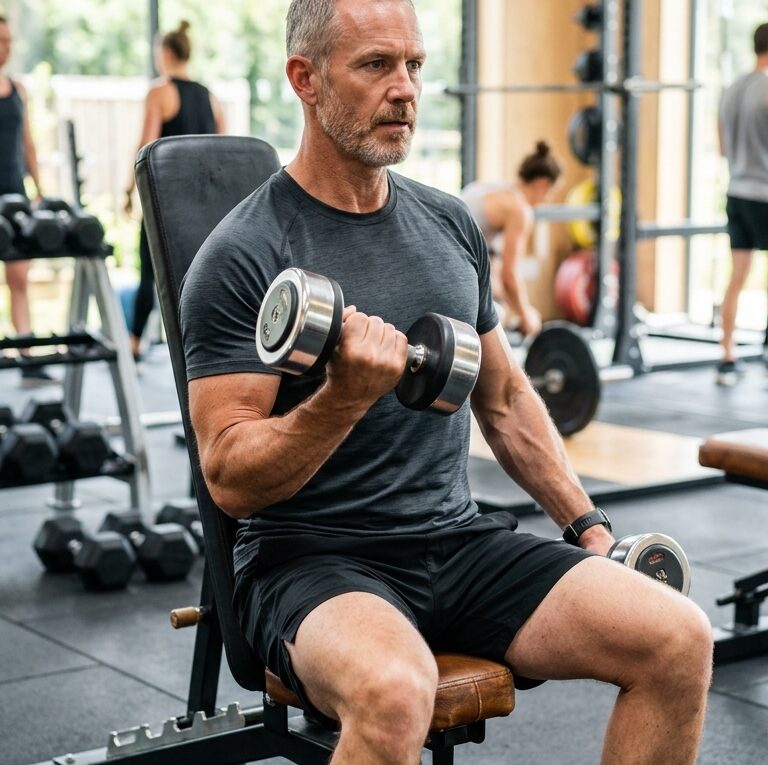
Muscle Loss After 50: Why It Happens and How Men Can Rebuild Strength
Most men over 50 notice it before they have a name for it. The weights they used to lift feel heavier. Recovery takes longer. Muscle definition fades. What’s happening has a clinical name — sarcopenia — and it’s one of the most consequential and least discussed aspects of male aging.
The good news: muscle loss after 50 is not inevitable. The decline is real, but it’s significantly reversible with the right approach. This guide explains why it happens and exactly what works to rebuild strength at 50, 60, and beyond.
What Is Sarcopenia and Why Does It Happen?
Sarcopenia is the age-related loss of skeletal muscle mass, strength, and function. It begins gradually in the 30s (roughly 3–5% per decade), accelerates in the 50s, and can become dramatic after 60 without intervention — some estimates suggest losses of 1–2% of muscle mass per year after 50.
Multiple factors drive this:
- Declining anabolic hormones: Testosterone, growth hormone, and IGF-1 all decrease with age. These hormones are the primary signals that trigger muscle protein synthesis.
- Anabolic resistance: Muscle cells in older adults become less responsive to protein and exercise stimuli — meaning you need more of both to get the same growth signal.
- Inflammation: Chronic low-grade inflammation interferes with muscle protein synthesis and promotes muscle protein breakdown.
- Reduced physical activity: Many men become more sedentary with age — which accelerates the very decline they’re trying to avoid.
- Inadequate protein intake: Older adults often eat less protein, sometimes due to appetite changes or dietary preferences, while actually needing more.
Why Muscle Loss After 50 Matters Beyond Appearance
This isn’t just about looking good. Muscle mass is directly correlated with metabolic health, insulin sensitivity, fall risk, fracture risk, immune function, and overall mortality. Men with higher muscle mass live longer and maintain functional independence longer. Sarcopenia is increasingly recognized as a predictor of cardiovascular disease, type 2 diabetes, and cognitive decline.
How to Rebuild Muscle After 50
1. Resistance Training — Non-Negotiable
Progressive resistance training is the most powerful stimulus for muscle preservation and growth at any age. Older adults can build muscle just as effectively as younger adults when training intensity and volume are adequate — it just takes a bit more stimulus due to anabolic resistance.
Key principles for men over 50:
- Train each muscle group 2–3 times per week
- Use loads that challenge you by the last few repetitions (8–12 rep range is effective)
- Focus on compound movements: squats, deadlifts, rows, presses, pulls
- Progressive overload — gradually increasing weight or reps over time — is the essential driver
- Allow adequate recovery between sessions: 48+ hours per muscle group
2. Increase Protein Intake Significantly
The current RDA for protein (0.8 g per kg of bodyweight) is far too low for older adults trying to maintain or build muscle. Research consistently supports 1.6–2.2 g of protein per kg of bodyweight for older adults engaged in resistance training.
For a 180-lb man (82 kg), that’s roughly 130–180 g of protein daily. Distribution matters too: consuming 30–40 g per meal appears to maximally stimulate muscle protein synthesis, whereas spreading the same amount across 6 small servings is less effective.
Leucine — the amino acid that directly triggers muscle protein synthesis — is found highest in animal proteins (beef, chicken, fish, eggs, dairy) and is the reason whey protein is particularly effective for post-workout supplementation.
3. Creatine Supplementation
Creatine monohydrate has more research behind it than virtually any other sports supplement, and its benefits for older adults are substantial. In men over 50, creatine supplementation combined with resistance training produces greater increases in strength and muscle mass than training alone. It’s inexpensive, safe, and well-tolerated. A standard dose of 3–5 g daily is effective without loading.
4. Address Low Testosterone
Testosterone plays a fundamental role in muscle protein synthesis. Men who are significantly hypogonadal (low testosterone) will struggle to build muscle regardless of training and diet. If you’re doing everything right but making no progress, a testosterone panel is warranted. Our article on low testosterone after 40 covers symptoms, testing, and options in detail.
5. Prioritize Sleep and Recovery
Growth hormone is primarily secreted during deep sleep. Inadequate sleep directly impairs muscle protein synthesis and recovery. Men over 50 who sleep less than 7 hours per night show significantly greater muscle loss over time than those sleeping 7–9 hours. Sleep quality is as important as training for muscle maintenance.
Frequently Asked Questions
Can men over 60 really build significant muscle?
Yes — repeatedly demonstrated in research. Multiple randomized trials have shown that men in their 60s, 70s, and even 80s can make meaningful strength and muscle gains with consistent resistance training and adequate protein. The magnitude may be somewhat less than in younger men, but the capacity is absolutely there.
How long before you see results after 50?
Initial strength gains (neural adaptations) occur within 2–4 weeks. Visible muscle growth typically becomes apparent at 8–12 weeks of consistent training. Progress is real but patience matters — don’t assess results before 3 months.
Is cardio counterproductive for muscle building?
Excessive cardio can interfere with muscle gains (the “interference effect”), particularly if done in the same session as strength training. Moderate cardio for cardiovascular health is compatible with muscle building. Keep cardio and strength sessions separate when possible, and prioritize adequate caloric and protein intake to compensate for the additional energy expenditure.
What’s the best protein source for muscle building after 50?
Whey protein has the highest leucine content and fastest absorption profile — making it ideal post-workout. Casein protein (from dairy, digests slowly) is useful before bed to prevent overnight muscle breakdown. Whole food sources (beef, chicken, eggs, fish) are foundational. Plant proteins are lower in leucine and require higher amounts to achieve the same anabolic signal.
The Bottom Line
Muscle loss after 50 is real, but it’s not a fixed fate. With consistent resistance training 2–3 times per week, adequate protein (1.6–2.2 g/kg), creatine, and attention to sleep and hormonal health, men over 50 can not only halt the decline but genuinely rebuild meaningful strength and muscle mass. The most important thing is to start — because the men who maintain muscle into their 60s and 70s are overwhelmingly the ones who started training in their 40s and 50s.