

Menopause Symptom Relief: The Complete Guide
Medically reviewed content, last updated July 2026
Medical Disclaimer: This article is for educational purposes only and does not substitute for professional medical advice, diagnosis, or treatment. Always seek the guidance of your physician, gynecologist, or a certified menopause specialist regarding any medical condition, symptom, or treatment decision. Never disregard professional medical advice or delay seeking it because of something you have read here.

Table of Contents
- What Is Menopause, Really?
- The Numbers: How Common Are Menopause Symptoms?
- The Three Stages: Perimenopause, Menopause, Postmenopause
- The Most Common Symptoms — And Why They Happen
- Evidence-Based Relief Options
- Lifestyle Strategies That Actually Move the Needle
- Natural and Supplement-Based Approaches
- When to See a Doctor
- A Real-World Perspective
- Frequently Asked Questions
- Related Reading
What Is Menopause, Really? {#what-is-menopause}
Menopause is a single day on the calendar — the point marking exactly 12 consecutive months without a menstrual period — but the transition around it can last a decade or more. In Western populations, the median age of natural menopause is 51 years, though the transition typically begins between ages 46 and 55, and can start earlier for some women due to genetics, surgery, smoking, or certain medical treatments.<br>
What’s happening biologically is a gradual decline in ovarian follicles and, consequently, a drop in estrogen and progesterone production. This hormonal shift doesn’t just end fertility — estrogen receptors exist throughout the body, in the brain, skin, bladder, blood vessels, and bones, which is why menopause symptoms are so wide-ranging.
The Numbers: How Common Are Menopause Symptoms? {#the-numbers}
If you feel like menopause is hitting you harder than anyone told you it would, the data backs that up:
| Symptom or Fact | Reported Prevalence / Figure |
|---|---|
| Women experiencing vasomotor symptoms (hot flashes, night sweats) | 75–80% of U.S. women in menopause |
| Global range of hot flash prevalence | 50–85%, with the highest rates in Western countries |
| Average total duration of hot flashes | ~7.4 years, with some women reporting symptoms into their 80s |
| Women reporting genitourinary symptoms (vaginal dryness, urinary changes) | Up to 50% |
| Vaginal dryness prevalence in postmenopausal vs. premenopausal women | 44.8% vs. 21.2% — roughly double |
| U.S. women reaching natural menopause daily | Around 6,000/day, or 1.3 million per year |
| Women reporting difficulty sleeping during the transition | Roughly half |
Sources for the figures above include peer-reviewed data compiled in a 2024 clinical review of the menopause transition and a global meta-analysis of menopausal symptom prevalence, both indexed on PubMed Central.
These aren’t just statistics — they explain why so many women feel dismissed when told hot flashes or brain fog are “just part of aging.” The physiological impact is real, measurable, and in many cases, treatable.
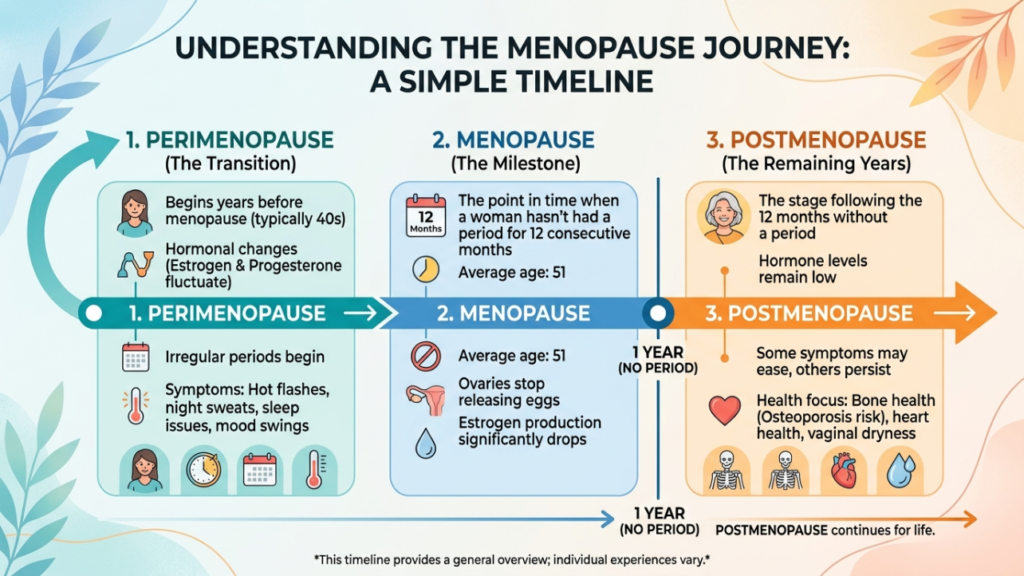
The Three Stages: Perimenopause, Menopause, Postmenopause {#three-stages}
Understanding where you are in the transition helps you and your doctor choose the right relief strategy.
- Perimenopause — Can begin in your late 30s to mid-40s and last 4–10 years. Estrogen levels fluctuate unpredictably (not just decline), which is why symptoms can feel erratic — heavier or lighter periods, sudden hot flashes, mood swings.
- Menopause — The single point in time after 12 months without a period.
- Postmenopause — Everything after that point, for the rest of life. Estrogen settles at a consistently low level, which raises long-term risks for bone loss (osteoporosis) and cardiovascular disease, making this stage important for preventive care, not just symptom relief.
The Most Common Symptoms — And Why They Happen {#common-symptoms}
Hot flashes and night sweats (vasomotor symptoms). Estrogen decline affects the hypothalamus — your body’s internal thermostat — narrowing your “thermoneutral zone.” Small increases in core temperature that would normally go unnoticed trigger a full-blown heat-dissipation response: flushing, sweating, and a racing heart. A newer class of non-hormonal medications, NK3 receptor antagonists such as fezolinetant, was FDA-approved in 2023 specifically because it targets this exact neural pathway, and clinical trials (SKYLIGHT 1, 2, and 4) showed meaningful reductions in hot flash frequency and severity.
Sleep disruption. Night sweats are one culprit, but declining progesterone (which has a natural sedative effect) and increased anxiety also independently disrupt sleep architecture.
Vaginal dryness and urinary changes (Genitourinary Syndrome of Menopause, or GSM). Estrogen keeps vaginal and urinary tract tissue thick, elastic, and well-lubricated. As it drops, tissues thin out, leading to dryness, discomfort during intercourse, and — for many women — more frequent urinary tract infections or urgency. Unlike hot flashes, GSM tends to worsen over time without treatment rather than resolve on its own.
Mood changes, brain fog, and irritability. Estrogen influences serotonin and norepinephrine pathways. Combined with sleep loss, this is why irritability, anxiety, and difficulty concentrating are so frequently reported — one African cohort study found depressive mood in 46% and anxiety in nearly 40% of perimenopausal and postmenopausal women.
Bone and cardiovascular changes. These are the “silent” symptoms — you may not feel them, but postmenopausal bone loss accelerates in the first 5–7 years after the final period, raising fracture risk later in life.
Evidence-Based Relief Options {#relief-options}
1. Menopausal Hormone Therapy (MHT/HRT)
According to a 2025 narrative review of contemporary evidence, hormone therapy remains the most effective treatment for moderate-to-severe hot flashes and night sweats, and it is also the first-line treatment for genitourinary syndrome of menopause, particularly low-dose vaginal estrogen. It can additionally help prevent early postmenopausal bone loss.
Modern guidance has moved away from the blanket fear that followed the early-2000s Women’s Health Initiative reports. Mayo Clinic women’s health specialists now emphasize a personalized approach: the benefit-risk profile depends heavily on the route of administration (patch, gel, spray, or oral), the dose, and — critically — how soon after menopause therapy begins. Initiating therapy within 10 years of menopause, using transdermal (skin-applied) low-to-moderate dose estradiol, is generally considered the more favorable option for women with cardiometabolic risk factors.
2. Non-Hormonal Prescription Options
For women who can’t or prefer not to use hormones, options include:
- SSRIs/SNRIs (originally antidepressants), shown to reduce hot flash frequency by roughly 40–60%
- Fezolinetant (Veozah), a non-hormonal NK3 receptor antagonist, reducing VMS by an estimated 50–65% in trials
- Cognitive behavioral therapy (CBT) and clinical hypnosis, both shown in Mayo Clinic-cited research to meaningfully ease menopausal symptoms without medication
3. Local (Vaginal) Estrogen
For GSM specifically, low-dose vaginal estrogen (creams, tablets, or rings) delivers relief directly to affected tissue with minimal systemic absorption, making it an option even for many women who can’t use systemic hormone therapy.
Lifestyle Strategies That Actually Move the Needle {#lifestyle}
Lifestyle changes won’t eliminate a strong hormonal symptom on their own, but a Lebanese cross-sectional study of over 600 women found clear associations between hot flash severity and modifiable factors like smoking, BMI, and spicy food intake — meaning these levers are worth pulling:
- Layered clothing and cooling strategies for immediate hot flash management
- Regular strength training, which helps offset both bone density loss and the metabolic slowdown common in this life stage
- Limiting alcohol, caffeine, and spicy foods, common (though individual) hot-flash triggers
- Consistent sleep hygiene — cool bedroom, consistent wake time, and limiting screens before bed
- Stress-reduction practices such as paced breathing, yoga, or mindfulness-based stress reduction, which have modest but real evidence for reducing hot flash bother

Natural and Supplement-Based Approaches {#supplements}
Many women look for non-prescription support, whether alongside medical treatment or as a starting point before deciding on hormone therapy. Research on options like phytoestrogens (plant compounds that weakly mimic estrogen), black cohosh, and other botanical blends is mixed — some studies show modest benefit for mild-to-moderate symptoms, while others show no significant difference from placebo. This is an active area of research, and a 2026 pharmacology review specifically flags plant-based compounds and other non-hormonal innovations as an emerging (not yet fully settled) field.
If you’re researching supplement options as part of your own decision-making, it helps to read independent evaluations rather than relying on marketing claims alone. For example, several in-depth consumer reviews cover a women’s hormone-support supplement called FemiCore, examining its ingredient list, ingredient dosages, and real user feedback:
- FemiCore Review 2026: What You Should Know Before You Buy
- Does FemiCore Work? A Deep Dive Into Its Ingredients and Consumer Feedback (2026)
- FemiCore Reviews 2026: Does This Women’s Hormone Support Supplement Work?
- FemiCore Review: Natural Bladder Control & Urinary Comfort for Women
- FemiCore Review: Key Benefits, Bladder Control, and Urinary Microbiome Support
As with any supplement, talk to your doctor before starting — especially if you’re on other medications, since even “natural” ingredients can interact with prescriptions or existing health conditions.
Sleep is one of the areas most disrupted by menopause, and fixing your sleep environment and schedule can meaningfully reduce daytime fatigue and irritability. If insomnia or erratic sleep timing is a bigger issue for you than hot flashes themselves, our companion guide walks through it step by step: How to Reset Your Circadian Rhythm: A Practical Guide for Better Sleep.
When to See a Doctor {#see-a-doctor}
Reach out to a healthcare provider — ideally a gynecologist or a NAMS-certified menopause practitioner — if you experience:
- Hot flashes or night sweats that disrupt daily life or sleep most nights
- Vaginal bleeding after you’ve already gone 12 months without a period (this always warrants evaluation)
- Mood changes that feel like more than “irritability” — persistent low mood, loss of interest, or thoughts of self-harm
- Symptoms of a urinary tract infection (burning, urgency, frequency)
- Concerns about bone health, especially with a family history of osteoporosis or a low-impact fracture
A Real-World Perspective {#real-world}
Clinical trial data can feel abstract when you’re the one lying awake at 3 a.m. soaked in sweat for the third night that week. What tends to help women in practice is treating menopause as a management project, not a single problem to solve: tracking which symptoms are worst (a simple symptom journal for 2–3 weeks is often eye-opening), ruling out other causes with bloodwork, and then layering solutions — a sleep environment fix here, a medication trial there — rather than expecting one intervention to fix everything at once. Many women report that the biggest quality-of-life improvement doesn’t come from eliminating every symptom, but from finally having a plan and a clinician who takes the symptoms seriously.
Frequently Asked Questions {#faq}
How long do menopause symptoms typically last? Vasomotor symptoms last a median of about 7.4 years, though the range is wide — some women have them for a year or two, others into their 70s or 80s.
Is hormone therapy safe? For most healthy women within 10 years of menopause onset, current research and specialists describe modern, lower-dose, and transdermal hormone therapy options as generally safe — but “safe” depends on individual risk factors like clotting history, certain cancers, and cardiovascular disease. This decision should always be made with your physician.
Can diet alone control hot flashes? Diet and lifestyle changes can reduce the frequency and intensity of hot flashes for some women, but they rarely eliminate moderate-to-severe symptoms on their own. They work best combined with, not instead of, evidence-based treatment when symptoms are significant.
What’s the difference between perimenopause and menopause? Perimenopause is the transitional period leading up to menopause, marked by irregular periods and fluctuating hormones. Menopause itself is the single point marking 12 months without a period.
Do all women need treatment? No — some women pass through the transition with minimal symptoms. Treatment decisions should be based on how much symptoms affect your quality of life, not on symptoms alone.
Related Reading {#related-reading}
- FemiCore Review 2026: What You Should Know Before You Buy
- Does FemiCore Work? A Deep Dive Into Its Ingredients and Consumer Feedback (2026)
- FemiCore Reviews 2026: Does This Women’s Hormone Support Supplement Work?
- FemiCore Review: Natural Bladder Control & Urinary Comfort for Women
- FemiCore Review: Key Benefits and Urinary Microbiome Support
- How to Reset Your Circadian Rhythm: A Practical Guide for Better Sleep
External, authoritative sources referenced in this article:
- Mayo Clinic News Network — Hormone therapy: Four things a Mayo Clinic women’s health specialist wants you to know
- Mayo Clinic News Network — Coping with menopause: Can hormone therapy help?
- PubMed Central — Menopause Decoded: What’s Happening and How to Manage It
- PubMed Central — Mapping global prevalence of menopausal symptoms among middle-aged women: a systematic review and meta-analysis
- PubMed Central — FDA approves Veozah (Fezolinetant) for menopausal symptoms
- PubMed Central — Menopausal Hormone Therapy—Risks, Benefits and Emerging Options: A Narrative Review
Medical Disclaimer (repeated for clarity): This guide is intended for general informational purposes only and is not a substitute for professional medical advice, diagnosis, or treatment offered by a licensed healthcare provider. Individual results and appropriate treatment vary based on personal health history. Always consult your doctor before starting, stopping, or changing any treatment, medication, or supplement.
Tags: #Menopause #MenopauseRelief #HotFlashes #WomensHealth #Perimenopause #HormoneTherapy #MenopauseSupport #NightSweats #MidlifeHealth #FemiCore