

The Gut-Brain Connection: How Your Microbiome Affects Mood, Energy, and Health
The phrase “gut-brain connection” gets used a lot — often in ways that sound more mystical than scientific. But the relationship between your gut microbiome and your brain is not a wellness metaphor. It is a documented, mechanistically understood biological pathway that influences your mood, your anxiety levels, your energy, your cognitive function, and even your long-term neurological health.
Understanding the gut-brain connection changes how you think about mental health, energy, and the seemingly unrelated choices you make about what you eat.
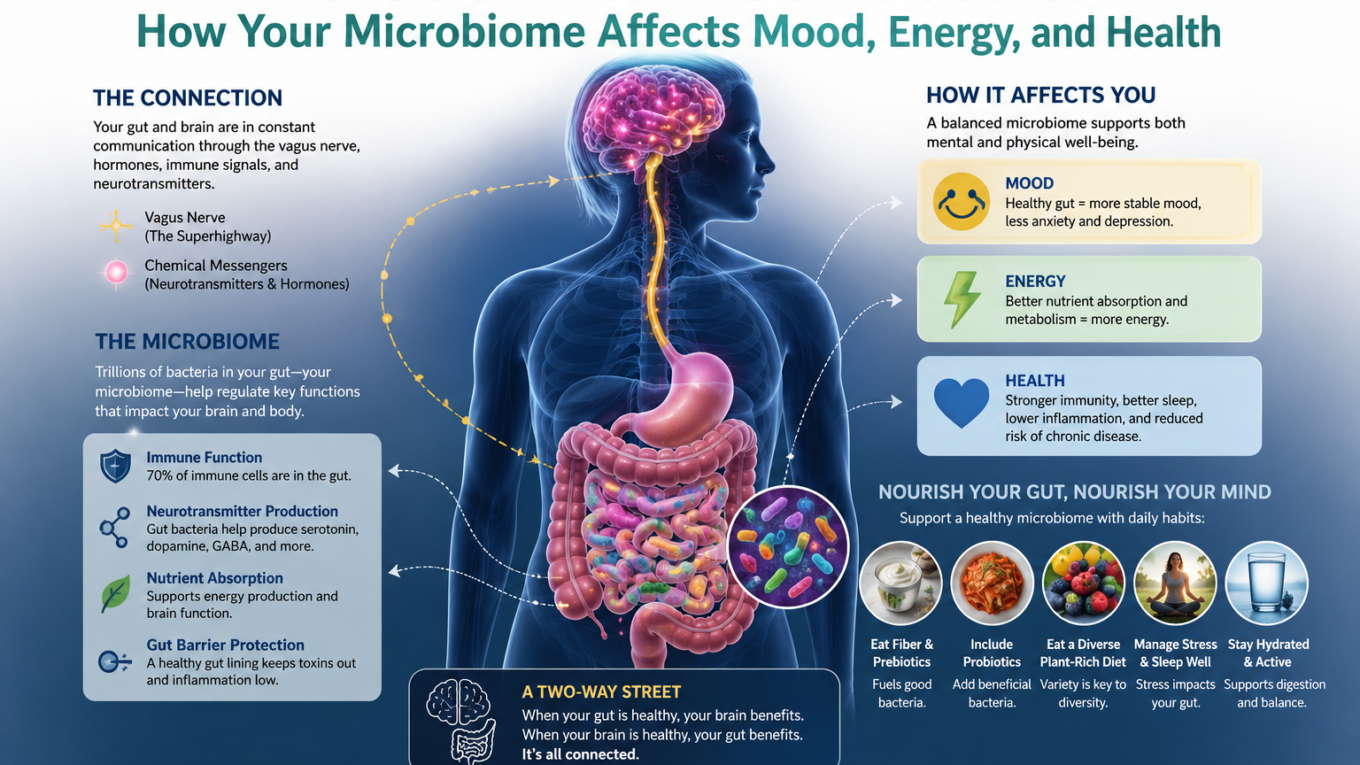
The Anatomy of the Gut-Brain Axis
The gut and brain communicate through multiple channels simultaneously:
- The vagus nerve — a bidirectional superhighway connecting the gut and brain; roughly 80-90% of its signals travel upward (from gut to brain), not downward
- The enteric nervous system — the “second brain,” a network of approximately 500 million neurons in the gut wall that functions semi-independently and communicates with the central nervous system
- The immune system — gut bacteria influence systemic immune signaling, which affects neuroinflammation and brain function
- The endocrine system — gut cells produce over 20 hormones including serotonin, ghrelin, and GLP-1, which travel through the bloodstream to the brain
- Short-chain fatty acids (SCFAs) — produced by gut bacteria fermenting fiber; cross the blood-brain barrier and have direct effects on neuroinflammation, mood, and cognition
How the Gut Microbiome Affects Your Brain
Serotonin Production
Approximately 90-95% of the body’s serotonin is produced in the gut, not the brain. Gut bacteria influence this production through their effects on enterochromaffin cells and tryptophan metabolism. Serotonin produced in the gut doesn’t directly cross the blood-brain barrier, but it does regulate intestinal function and sends signals upstream via the vagus nerve. The gut-brain axis creates a system where gut microbiome composition influences overall serotonin signaling — which is why gut dysbiosis correlates with mood disorders.
GABA Signaling
Multiple Lactobacillus and Bifidobacterium species produce GABA — the brain’s primary inhibitory neurotransmitter. GABA reduces anxiety, promotes calm, and is the target of benzodiazepine drugs. Certain probiotic strains appear to increase GABA production in the gut, with studies in mice showing reduced anxiety and stress responses. Human clinical data on this specific mechanism is still emerging, but the pathway is established.
Neuroinflammation
Gut dysbiosis — an imbalanced microbiome with reduced diversity and increased harmful species — increases gut permeability (the much-discussed “leaky gut”). Bacterial lipopolysaccharides (LPS) from gram-negative bacteria can translocate across a permeable gut lining into systemic circulation, triggering an inflammatory response. This neuroinflammation is increasingly implicated in depression, anxiety, cognitive decline, and neurodegenerative diseases including Alzheimer’s and Parkinson’s.
Cortisol and Stress Reactivity
The microbiome modulates the HPA axis — the system governing cortisol production and stress response. Germ-free animal studies demonstrate dramatically elevated stress reactivity in animals without microbiome; colonization with specific beneficial strains normalizes the stress response. Human studies show that probiotic supplementation reduces cortisol output and anxiety scores in people under psychological stress.
Cognitive Function and Memory
Gut bacteria produce neurotrophic factors — including BDNF (brain-derived neurotrophic factor) — that support neurogenesis (new neuron formation) and synaptic plasticity. BDNF is often called “fertilizer for the brain” and is associated with learning, memory, and protection against cognitive decline. Dietary patterns that support microbiome diversity (high-fiber, plant-rich diets) are consistently associated with higher BDNF and better cognitive outcomes in epidemiological studies.
Signs Your Gut-Brain Axis May Be Dysregulated
- Anxiety that co-occurs with digestive symptoms
- Depression or low mood with no clear psychological trigger
- Brain fog and poor concentration
- Fatigue that sleep doesn’t fully resolve
- Irritable bowel syndrome (IBS) — the gut-brain axis is central to its pathophysiology
- Chronic low-grade bloating, gas, or inconsistent digestion
- Poor stress resilience — stress hits the gut first
How to Optimize Your Gut-Brain Axis
Prioritize Dietary Fiber and Diversity
Fiber is the fuel that beneficial gut bacteria ferment to produce the short-chain fatty acids that support brain health. Target 30+ different plant foods per week — variety matters more than quantity. Each plant species feeds different bacterial communities; monotonous diets, even healthy ones, reduce microbiome diversity over time. Prebiotic fibers (in garlic, onions, leeks, asparagus, Jerusalem artichokes, and chicory root) specifically feed beneficial Lactobacillus and Bifidobacterium species.
Add Fermented Foods Daily
A landmark 2021 Stanford study found that a diet high in fermented foods significantly increased microbiome diversity and reduced inflammatory markers — more effectively than a high-fiber diet alone over 10 weeks. Regular consumption of yogurt, kefir, kimchi, sauerkraut, kombucha, miso, or tempeh introduces live beneficial organisms and their metabolic products into the gut environment.
Targeted Probiotic Supplementation
Specific strains have been studied for gut-brain effects:
- Lactobacillus helveticus R0052 + Bifidobacterium longum R0175 (the combination in multiple human trials) — reduced anxiety and depression scores significantly in clinical studies
- Lactobacillus rhamnosus — reduces anxiety behavior in animal models; human studies show cortisol reduction
- Bifidobacterium longum NCC3001 — reduced depression scores in IBS patients with comorbid depression in a 2019 RCT
“Psychobiotics” — probiotics with evidence for brain effects — are an active research area. Products targeting mood and stress with these specific strains are distinct from general digestive probiotics.
Omega-3 Fatty Acids
EPA and DHA support the integrity of the gut lining (reducing permeability), reduce neuroinflammation, and support BDNF production. The anti-inflammatory effect of omega-3s acts at both the gut and brain levels. High-EPA fish oil (at least 1,000mg EPA daily) is the best-evidenced approach for mood and cognitive applications.
Reduce Gut Microbiome Disruptors
Several common habits damage gut microbiome diversity:
- Antibiotics — necessary when required, but their microbiome impact should be mitigated with probiotic supplementation during and after treatment
- Ultra-processed foods — emulsifiers (polysorbate 80, carrageenan) in processed foods have been shown to directly disrupt gut lining integrity
- Artificial sweeteners — some (sucralose, saccharin) negatively alter microbiome composition
- Chronic alcohol — disrupts Lactobacillus dominance and increases gut permeability
- Chronic stress — directly impairs gut motility and mucosal integrity through the gut-brain axis itself
Exercise — Directly Improves Microbiome Diversity
Multiple studies have found that regular aerobic exercise independently increases gut microbiome diversity and butyrate-producing bacteria — regardless of diet. The effect is bidirectional: the microbiome also influences exercise motivation and performance through gut-brain signaling. Athletes consistently show higher microbiome diversity than sedentary individuals, even when controlling for diet.
Frequently Asked Questions
Can fixing your gut improve your mental health?
The evidence suggests yes, for some people. Several randomized trials have found that targeted probiotic supplementation, particularly specific psychobiotic strains, reduces anxiety and depression scores. The effect is most pronounced in people with both gut symptoms and mood symptoms — suggesting gut-brain axis dysregulation as a shared mechanism. This doesn’t replace mental health care but can be a meaningful complementary approach.
What is the best probiotic for mental health?
The combination of Lactobacillus helveticus R0052 and Bifidobacterium longum R0175 has the most clinical human data for psychological outcomes. Products containing these specific strains (often marketed as psychobiotics) are distinct from general digestive probiotics, which may or may not contain brain-relevant strains.
What does an unhealthy gut feel like?
Physically: bloating, irregular bowel movements, gas, frequent indigestion, food sensitivities, and abdominal discomfort. Systemically: persistent fatigue, frequent illness, skin issues (acne, eczema), brain fog, poor mood resilience, and slow recovery from stress. Many of these symptoms improve substantially with gut microbiome restoration.
How long does it take to improve gut health?
Measurable changes in gut microbiome composition can occur within 2-3 days of significant dietary changes (adding fiber and fermented foods), according to microbiome research. Meaningful clinical improvement in symptoms typically takes 4-8 weeks. Full microbiome restoration after disruption (antibiotics, illness) takes 3-6 months with consistent support.
Does the gut microbiome affect weight?
Yes — microbiome composition influences how many calories are extracted from food, how fat is stored, and how appetite hormones (ghrelin, GLP-1, peptide YY) are regulated. Transplanting gut bacteria from obese mice into lean germ-free mice produces obesity in the recipients — a dramatic demonstration of the microbiome’s metabolic power. In humans, higher microbiome diversity is consistently associated with healthier metabolic profiles.
Your Gut Is Not Separate From Your Brain
The separation between physical and mental health has always been somewhat artificial. The gut-brain axis makes it literally false: what happens in your gut affects your brain state, your stress resilience, your mood, your cognitive sharpness, and your energy levels. The same daily choices that support gut health — dietary diversity, fermented foods, adequate fiber, stress management, and regular exercise — also support brain health. They’re the same interventions, serving the same interconnected system.
2 thoughts on “The Gut-Brain Connection: How Your Microbiome Affects Mood, Energy, and Health”