

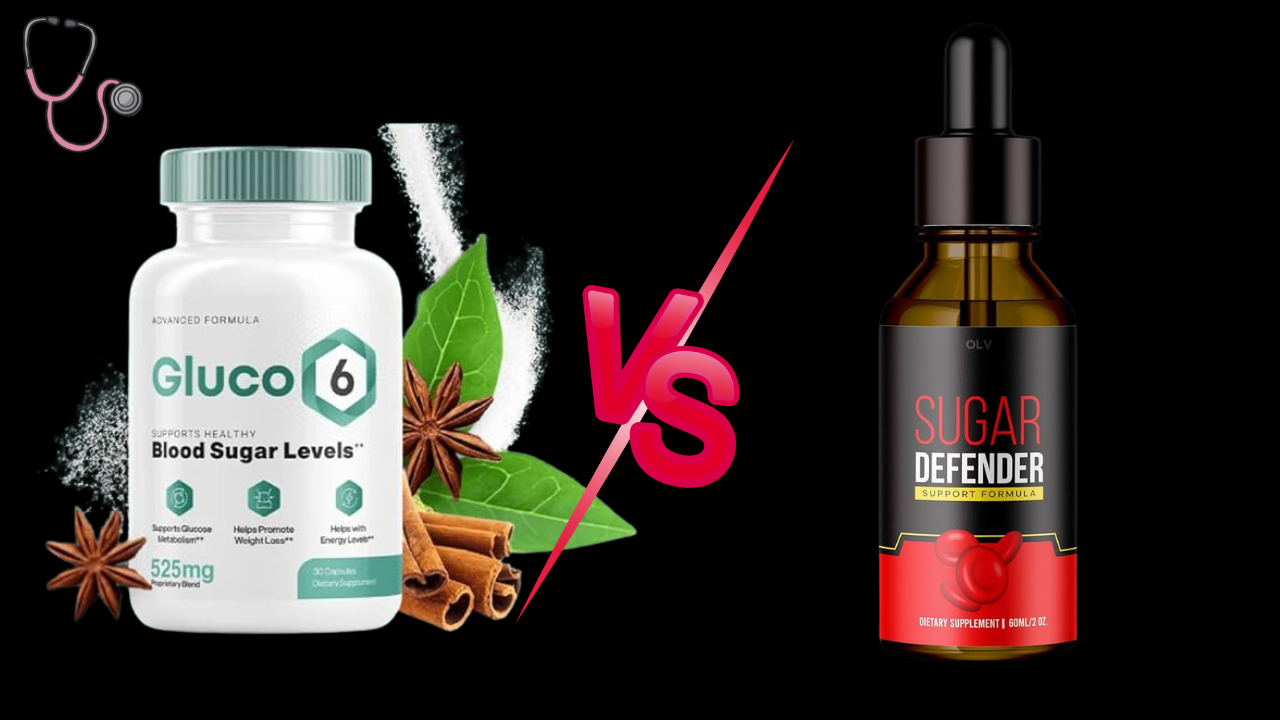
Gluco6 vs Sugar Defender:Which One Actually Works?
Gluco6 vs Sugar Defender: Which One Works? (2026 Evidence-Based Comparison)
Gluco6 vs Sugar DefenderInformational only · Not medical advice
Blood Sugar Supplements · Evidence Review
Gluco6 vs Sugar Defender:
Which One Actually Works?
Two of the most-marketed blood sugar supplements of 2026, compared side by side — ingredients, format, price, safety, and what the published science from the NIH, CDC and ADA really says.
By the Editorial TeamUpdated June 22, 2026~12 min readSources: NIH · CDC · ADA · NIDDK
Medical disclaimer This article is for general information only and does not substitute for professional medical advice, diagnosis, or treatment. Neither product is FDA-approved or intended to diagnose, treat, cure, or prevent any disease. Never start, stop, or change a supplement or medication without talking to your doctor or pharmacist first — especially if you take glucose-lowering drugs, where adding a supplement can risk low blood sugar (hypoglycemia).
Affiliate disclosure Some links below are affiliate links. If you buy through them, we may earn a commission at no extra cost to you. This never changes the price you pay, and — as you’ll see — it didn’t stop us from telling you where the evidence is thin.
The short answer
Be wary of anyone who tells you one of these “works” and the other doesn’t. Neither Gluco6 nor Sugar Defender has a published, independent clinical trial on its finished formula. Both are built on overlapping botanicals — gymnema, chromium, cinnamon — that the U.S. National Center for Complementary and Integrative Health rates as weak or mixed evidence at best. The honest difference between them is format and ingredient philosophy, not proven superiority. If you want to try one as a complement to real care, the right pick depends on whether you prefer a focused capsule or a broad liquid — details below.
If you’ve searched “Gluco6 vs Sugar Defender,” you’ve probably already waded through a swamp of near-identical “review” pages promising a miracle. This isn’t that. We pulled the marketing claims, separated them from the actual research, and lined the two products up against the same yardstick so you can decide for yourself.
01Why blood sugar is worth getting right
Before comparing pills and drops, it helps to know what “good” blood sugar even means. According to the CDC, roughly 1 in 3 American adults has prediabetes — and most don’t know it. That’s the audience both of these products are built for: people who’ve seen a borderline lab result and want to do something before it becomes a diagnosis.
Here are the diagnostic ranges clinicians actually use, straight from the American Diabetes Association’s 2026 Standards of Care and the CDC. Drag the slider to see where a fasting reading lands.
Interactive: where does a fasting glucose reading fall?
// fasting plasma glucose, mg/dL — educational only
NORMAL
PREDIABETES
DIABETES
95 mg/dLNormal range
| Test | Normal | Prediabetes | Diabetes |
|---|---|---|---|
| Fasting glucose (FPG) | < 100 mg/dL | 100–125 mg/dL | ≥ 126 mg/dL |
| A1C (3-month average) | < 5.7% | 5.7–6.4% | ≥ 6.5% |
| 2-hr OGTT | < 140 mg/dL | 140–199 mg/dL | ≥ 200 mg/dL |
Sources: ADA · CDC · NIDDK. For most non-pregnant adults with diabetes, the ADA suggests an A1C target below 7%.
Keep these numbers in mind. They’re the only objective scoreboard that tells you whether anything you try is helping — supplement or not.
02Meet the two contenders
Gluco6 — the focused capsule
Gluco6, sold by Good Mix Naturals, is a six-ingredient capsule taken daily. Its marketing leans hard on a single idea: supporting the GLUT-4 glucose transporter so cells absorb sugar more efficiently. The “Super 6” blend is Sukre™, TeaCrine®, gymnema sylvestre, chromium, cinnamon, and green tea extract. The company says it’s made in an FDA-registered, GMP-certified U.S. facility and offers a 60-day money-back guarantee.
One honest caveat on the hype: phrases like “Harvard-backed science” and big round customer counts appear across promotional pages, but we found no independent source verifying them. Treat them as marketing, not data.
Sugar Defender — the broad liquid
Sugar Defender takes the opposite approach: a sublingual liquid (a 60 mL dropper bottle, about a month’s supply) with a sprawling list of around 24 ingredients, eight of them highlighted as primary actives — gymnema, chromium, African mango, eleuthero, ginseng, coleus forskohlii, guarana, and maca root. You place drops under the tongue, typically before breakfast. It also claims FDA-registered/GMP manufacturing and a 60-day guarantee. Note that the guarana means it likely contains caffeine, which matters if you’re sensitive.
The overlap nobody mentions Strip away the branding and both products are anchored by the same two ingredients: gymnema and chromium. Gluco6 surrounds them with cinnamon and green tea; Sugar Defender surrounds them with a much longer botanical list. So a lot of the “which is better” question is really: do you want a tight formula at higher per-ingredient doses, or a wide net at smaller doses?
Capsule · 60-day guarantee Check Gluco6 View official page → Liquid drops · 60-day guarantee Check Sugar Defender View official page →
03Head-to-head comparison
Tap through the tabs to compare the two on the things that actually differ.
Gluco6
capsule · 6 ingredients
Sugar Defender
liquid drops · ~24 ingredientsAt a glanceIngredientsUse & formatPrice & guarantee
Best suited forPeople who want a simple, focused capsule routine.
Best suited forPeople who like liquids and a “kitchen-sink” botanical blend.
Core activesGymnema, chromium, cinnamon, green tea (+ Sukre™, TeaCrine®).
Core activesGymnema, chromium, African mango, ginseng, eleuthero (+ more).
StimulantsTeaCrine®/green tea — mild.
StimulantsGuarana — contains caffeine.
PhilosophyFewer ingredients, marketed at meaningful doses, GLUT-4 angle.
PhilosophyMany ingredients, broad coverage, smaller individual amounts.
Label transparencyLists all 6 with no proprietary blend, per the brand.
Label transparencyPublishes its list, but full per-ingredient doses are less clear.
Independent dosage testingNone published.
Independent dosage testingNone published.
FormatSwallowed capsule.
FormatDrops held under the tongue (sublingual).
RoutineDaily with water; easy if you already take pills.
RoutineOne dropperful, usually before breakfast; easy if you dislike pills.
TasteNeutral (capsule).
TasteHerbal/neutral liquid; most reviews call it tolerable.
Typical pricingSold per bottle on the official site, with multi-bottle discounts. Prices change — confirm on the page.
Typical pricingSame model: single bottle or discounted 3/6-bottle bundles. Confirm current pricing on the page.
Guarantee60-day money-back, per the brand.
Guarantee60-day money-back, per the brand.
Where to buyOfficial site only (avoid third-party marketplace copies).
Where to buyOfficial site only (counterfeits are common elsewhere).
04What the science actually says about the ingredients
This is where the real comparison lives — not in either brand’s testimonials, but in the independent research on the compounds inside them. Here’s the sober read from the NIH’s National Center for Complementary and Integrative Health (NCCIH) and peer-reviewed reviews.
Chromium Weak / mixed evidence
A 2022 review of 16 studies (868 participants) suggested chromium may modestly improve A1C, fasting glucose and insulin resistance in type 2 diabetes. But another 2022 meta-analysis of 10 studies found no effect on fasting glucose — though it still saw an A1C reduction. In short: a signal, but an inconsistent one.
In both products · Side effects can include stomach upset; rare reports of kidney/liver issues at high doses (NCCIH).
Cinnamon Weak / mixed evidence
A 2019 review of 16 studies (1,098 participants) found cinnamon helped lower fasting glucose and insulin resistance in people with prediabetes or type 2 diabetes. Yet a Cochrane review of 10 randomized trials concluded the data are conflicting, partly because doses and cinnamon types varied widely. Promising, not proven.
In Gluco6 · Generally well tolerated in food amounts.
Gymnema Sylvestre Limited human data
The “sugar destroyer” has centuries of traditional use and some small studies on glucose absorption and sweet-craving reduction, but large, high-quality trials are scarce. Most evidence is early-stage.
In both products.
African mango, ginseng, eleuthero, coleus, guarana Thin for blood sugar
These appear mainly in Sugar Defender. Individual ingredients have scattered research for metabolism, energy or weight, but evidence specifically for blood-sugar control is limited, and combining many botanicals at small doses makes it hard to know what (if anything) is doing the work.
In Sugar Defender.
Sukre™ & TeaCrine® (branded compounds) Brand-specific, unverified
These are Gluco6’s headline differentiators. Because they’re proprietary, there’s no independent, peer-reviewed trial on them in this exact context that we could locate. The GLUT-4 storyline is a plausible mechanism, not a demonstrated outcome.
In Gluco6.
The bottom line from the NIH The NCCIH’s own summary is blunt: for a few supplements like chromium and cinnamon there’s weak evidence of possible benefit, but “we don’t have reliable evidence that any herbal supplements can help to control diabetes.” The FDA separately warns against any product claiming to be a “natural diabetes cure” or to replace medication. Do not stop prescribed treatment to take either of these.
05The “real experience” question — handled honestly
Every review site will show you glowing testimonials: stabilized readings, fewer cravings, more energy in 2–4 weeks. Here’s the part they skip — those stories are self-reported and unverified, collected by the sellers themselves. They’re not the same as measured outcomes, and they can’t tell you whether the supplement, a parallel diet change, or simple placebo did the work.
So what can you realistically expect? Based on the ingredient evidence above, the most plausible real-world effect is modest: a small nudge in fasting glucose or cravings for some people, layered on top of the things that genuinely move the needle — food, movement, sleep, and weight. If you want to know whether either product is doing anything for you, do the one thing testimonials never do:
A simple, honest self-test
1. Get a baseline first — a recent A1C from your doctor, or two weeks of fasting finger-stick readings. 2. Change nothing else while you trial the supplement. 3. Re-measure after 8–12 weeks (A1C reflects ~3 months). 4. Compare against the ranges in the table above. If the numbers don’t move, the 60-day guarantee exists for a reason.
That’s the closest thing to “experience” that’s worth anything: your own data, against a clinical reference range.
06Safety & who should be cautious
“Natural” is not the same as “harmless.” A few groups should talk to a clinician before trying either product:
| If you… | Why it matters |
|---|---|
| Take insulin or glucose-lowering drugs | Adding a blood-sugar-lowering supplement can stack effects and cause hypoglycemia. |
| Have kidney or liver disease | High-dose chromium has rare links to kidney and liver injury (NCCIH). |
| Are pregnant or breastfeeding | Safety data for these blends is lacking; both brands advise against use. |
| Are caffeine-sensitive | Sugar Defender’s guarana adds caffeine; Gluco6 has milder stimulant content. |
| Take other medications | Botanicals can interact; a pharmacist can check for conflicts. |
Safety notes adapted from NCCIH.
07So — which one should you pick?
If you’ve read this far, you already know the disappointing-but-truthful answer: there’s no proven winner. But there is a sensible way to choose between them if you’ve decided to try one alongside (never instead of) real care:
Lean Gluco6 if…
You prefer a simple capsule, want a shorter ingredient list you can actually evaluate, and like that it concentrates on a handful of the better-studied compounds (chromium, cinnamon, gymnema) rather than spreading thin across two dozen.
Lean Sugar Defender if…
You dislike swallowing pills, prefer a sublingual liquid, and are drawn to a broad botanical blend that also targets energy and appetite — and you’re not sensitive to caffeine.
What works best of all The interventions with the strongest evidence aren’t on this page in a bottle. They’re losing modest weight if you carry extra, moving most days, building meals around fiber and protein, and sleeping enough. The CDC’s National Diabetes Prevention Program can cut progression to type 2 diabetes substantially — far more than any supplement has been shown to. Use either product, if at all, as a small add-on to that foundation, and keep your doctor in the loop.
08Frequently asked questions
Is Gluco6 or Sugar Defender better? +
Neither has an independent clinical trial proving the finished formula works, and they share their core ingredients (gymnema, chromium). The better choice is the one whose format and ingredient style fits you — a focused capsule (Gluco6) or a broad liquid (Sugar Defender). “Better” here means better suited to you, not clinically superior.Can either supplement replace my diabetes medication? +
No. The NIH and FDA are explicit that no dietary supplement should replace prescribed diabetes treatment, and the FDA warns against products marketed as a natural cure. Stopping medication can be dangerous. Talk to your doctor before changing anything.How fast would I see results? +
Marketing pages often cite 2–4 weeks, but the only meaningful measure is your own labs. A1C reflects about three months of average glucose, so an 8–12 week trial with before-and-after numbers is the honest way to judge any effect.Are there side effects? +
Possible mild effects include stomach upset (chromium) and jitters from caffeine (Sugar Defender’s guarana). Rarely, high-dose chromium has been linked to kidney or liver problems. People on glucose-lowering drugs risk hypoglycemia. Check with a pharmacist about interactions.Where should I buy them? +
Both brands sell through their official sites and offer a stated 60-day money-back guarantee. Third-party marketplace listings are frequently counterfeit, so the official page is the safer route — and it’s where you can confirm the current price and refund terms.Do these contain caffeine? +
Sugar Defender includes guarana, a natural caffeine source, so it likely contains caffeine. Gluco6 contains milder stimulant-type ingredients (green tea, TeaCrine®). If you’re caffeine-sensitive, factor that in.
Sources & further reading
- Diabetes & Dietary SupplementsNIH · NCCIH
- Type 2 Diabetes & Supplements: the scienceNIH · NCCIH Clinical Digest
- A1C Test for Diabetes & PrediabetesCDC
- Diabetes Diagnosis & TestsAmerican Diabetes Association
- The A1C Test & DiabetesNIH · NIDDK
- Standards of Care in Diabetes — 2026ADA · Diabetes Care
Related on our site
- How to lower your A1C naturallyinternal guide
- Berberine vs metformin: what the data showsinternal guide
- The best time to check your blood sugarinternal guide
- 15 foods that spike blood sugar mostinternal guide
- All blood sugar supplement reviewsinternal hub
Medical disclaimer: This content is provided for educational and informational purposes only and is not a substitute for professional medical advice, diagnosis, or treatment. Always seek the guidance of your physician or other qualified health provider with any questions about a medical condition or before starting any supplement. Statements about Gluco6 and Sugar Defender have not been evaluated by the FDA; these products are not intended to diagnose, treat, cure, or prevent any disease.
Affiliate disclosure: This page contains affiliate links. We may earn a commission on qualifying purchases at no additional cost to you.
© 2026 · Editorial Team · Last reviewed June 22, 2026
You might also like! Gluco6 Review 2026: Does This Blood Sugar Supplement Actually Work?
You might also like! Gluco6 vs Sugar Defender: Which Blood Sugar Supplement Is Right for You?
You might also like! Gluco6 Review 2026: Does This Blood Sugar Supplement Actually Work?
You might also like! Gluco6 vs Sugar Defender: Which Blood Sugar Supplement Is Right for You?
One thought on “Gluco6 vs Sugar Defender:Which One Actually Works?”