

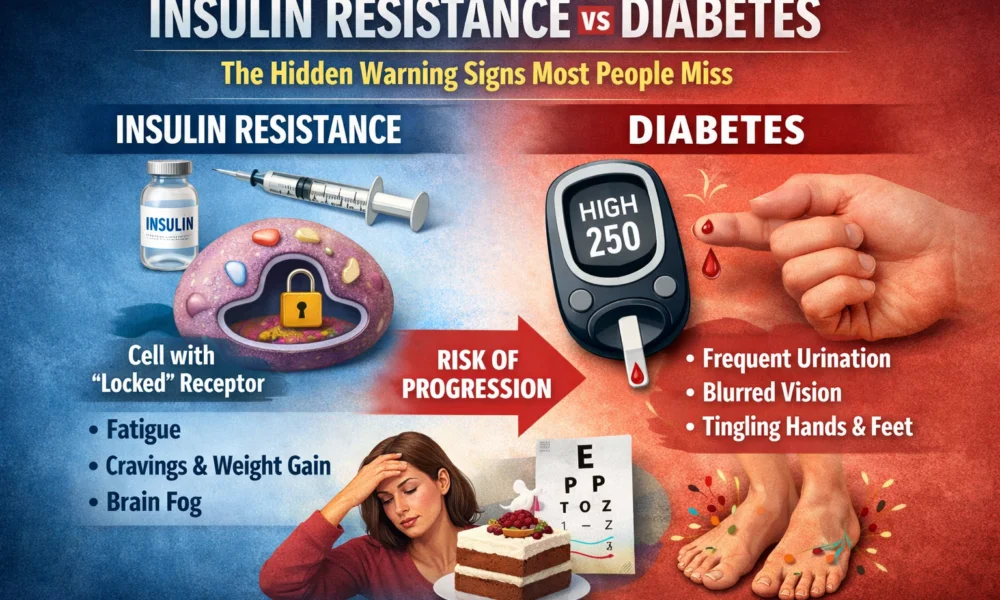
Early Signs of Insulin Resistance Most People Miss
You might also want to see this! How to Manage Blood Sugar Naturally After 40
You might want to see this! Gluco6 Review 2026: Does This Blood Sugar Supplement Actually Work?
Early Signs of Insulin Resistance Most People Miss
Your blood sugar can sit in the “normal” column on a lab report for up to a decade while something quietly shifts underneath it. By the time glucose finally climbs, the warning signs have usually been knocking for years — they’re just easy to mistake for ordinary life.
Insulin resistance is one of the most common metabolic conditions on the planet, and also one of the quietest. It develops when your cells stop responding efficiently to insulin — the hormone that ushers glucose out of your blood and into cells for fuel. The pancreas compensates by producing more, and for a long stretch that extra insulin keeps blood sugar in range. No alarm goes off. No single dramatic symptom appears.
The scale of it is striking. According to the U.S. Centers for Disease Control and Prevention, an estimated 97.6 million American adults — about 38% — already have prediabetes, the stage where insulin resistance has progressed enough to nudge glucose upward. The part that should make everyone pause: more than 8 in 10 of them don’t know it.
The encouraging flip side: insulin resistance is often the most reversible stage of the whole metabolic story. The window to act is precisely the window most people sleep through — because the early signs are subtle, ordinary-seeming, and easy to explain away. Below are the ones that most often go unnoticed.
9 early signs people routinely miss
None of these is a diagnosis on its own. Think of them as smoke, not fire — reasons to get curious and, if several line up, reasons to ask your doctor for a few specific blood tests.
The 3 p.m. energy crash after carb-heavy meals
You eat lunch — a sandwich, pasta, a sweet coffee — and 60 to 90 minutes later you’re flattened. Not “could use a coffee” tired. Need-to-lie-down tired. People blame the afternoon, the meeting, the season.
Why it happens: resistant cells force an oversized insulin release after carbs, which can overshoot and pull blood sugar down quickly. That post-meal swing — high, then a sharp dip — is what your body experiences as the crash.
Hunger and sugar cravings soon after eating
You finished a real meal an hour ago and you’re already foraging — specifically for something sweet or starchy. It feels like a willpower problem. It usually isn’t.
Why it happens: when cells resist insulin, glucose struggles to get inside them. The brain reads “low fuel” even with sugar circulating in the blood, and answers with cravings for the fastest fuel it knows — carbohydrates.
Brain fog that lifts and falls with meals
Words on the tip of the tongue, re-reading the same paragraph, a fuzziness that seems to track with what and when you last ate. It’s frequently chalked up to stress or poor sleep — both real, and both also worsened by insulin resistance.
Why it happens: the brain is an enormous glucose consumer and is sensitive to the same post-meal swings that cause the energy crash. Unstable fuel delivery shows up as unstable focus.
A waistline creeping up — without much else changing
Same routine, same rough diet, but the middle is expanding. Visceral fat (the deep abdominal kind) is both a driver and a consequence of insulin resistance, which makes it a self-reinforcing loop.
The number to know: elevated cardiometabolic risk is commonly flagged at a waist over 40 in / 102 cm in men and 35 in / 88 cm in women — measured at the belly button, after a normal breath out. Waist size often predicts metabolic risk better than weight on the scale alone.
Skin signals: dark velvety patches and new skin tags
Two skin changes are tied closely to high insulin. Acanthosis nigricans — dark, soft, velvety patches in the folds of the neck, armpits, or groin — is frequently mistaken for poor hygiene or a tan that won’t scrub off. A sudden crop of skin tags in those same friction zones is the other.
Why it happens: insulin is a growth-promoting hormone. When it’s chronically elevated, it can stimulate skin cells to multiply and thicken. These are among the few visible early clues — and among the most overlooked.
Waking to pee at night — and feeling extra thirsty
Once glucose starts edging up, the kidneys work to flush the excess, pulling water with it. The early version is mild: an extra bathroom trip at night, a thirst that water doesn’t quite satisfy. Easy to blame on “drinking too much before bed.”
Why it matters: this sign tends to appear a little later than the others, which is exactly why catching the earlier ones counts.
Sleep that quietly falls apart
Trouble falling asleep, 3 a.m. wake-ups, or unrefreshing sleep. The relationship runs both directions: insulin resistance can disrupt sleep, and short or poor sleep measurably reduces insulin sensitivity — even in healthy people after just a few bad nights.
Why it’s missed: sleep problems are so universal that almost no one connects them to metabolism. Yet protecting sleep is one of the higher-leverage things you can do for insulin sensitivity.
Hormonal shifts: irregular cycles, or low libido and ED
In women, high insulin can push the ovaries to make more androgens, disrupting ovulation — showing up as irregular or skipped periods, jaw-line acne, or unwanted hair growth. Insulin resistance sits at the center of PCOS, the most common hormonal disorder in women of reproductive age.
In men, insulin resistance is linked with lower testosterone and with erectile dysfunction, which can appear years before any blood-sugar diagnosis because the same blood-vessel and nerve changes underlie both.
Why it’s missed: these symptoms get routed to gynecology or urology and treated in isolation, while the shared metabolic root goes unexamined.
“Normal” labs that are quietly drifting
This is the sneakiest one, because it’s hiding in tests you may already have. Triglycerides creeping toward the top of normal while HDL (“good” cholesterol) slips down is a classic insulin-resistance signature. A fasting insulin that’s technically “in range” but high. An A1c sitting at high-normal, not yet flagged.
The tell: the triglyceride-to-HDL ratio is a cheap, accessible clue. Ratios above roughly 2.5 (women) or 2.8 (men) are associated with insulin resistance in many populations — though, importantly, this ratio is a far less reliable marker in people of African descent, so it shouldn’t be used in isolation.
Which of these sound like you?
Tap the ones you’ve noticed lately. This is a reflection tool, not a test — nothing is stored, and the result is not a diagnosis.
Estimate your HOMA-IR
HOMA-IR is a simple index that combines fasting glucose and fasting insulin to estimate insulin resistance — and it often turns abnormal years before fasting glucose alone does. It was first described by Matthews and colleagues in 1985. If you’ve had both values measured after an 8–12 hour fast, you can estimate yours here.
HOMA-IR calculator
Formula: (fasting insulin × fasting glucose) ÷ 405. Cutoffs vary by lab, assay, age and population — interpret with a clinician, not in isolation.
The numbers that actually catch it early
If you want to ask your doctor for the right panel, these are the markers worth a look. The “watch” flags below mark where many practitioners start paying closer attention — generally earlier than the official disease thresholds, because metabolic risk rises before the formal cutoffs.
| Marker | Reassuring | Worth a closer look |
|---|---|---|
| Fasting glucose | <100 mg/dL | 100–125 watch |
| HbA1c | <5.7% | 5.7–6.4% watch |
| Fasting insulin | ~2–8 µIU/mL | rising / high-normal |
| HOMA-IR | <1.0 optimal | >1.9 early · >2.9 significant |
| Triglycerides | <150 mg/dL | ≥150 watch |
| HDL cholesterol | ≥40 (men) / ≥50 (women) | below those |
| Triglyceride / HDL ratio | low | ≳2.8 (men) / ≳2.5 (women) |
| Waist circumference | <40 in (men) / <35 in (women) | above those |
Ranges reflect commonly cited values from the CDC, ADA and peer-reviewed literature. They are not universal — assays, populations, age and sex all shift the cutoffs, which is why interpretation belongs to your clinician.
What tends to actually move the needle
Insulin sensitivity responds well to consistent, unglamorous habits. None of this is a prescription — it’s the general direction the research keeps pointing, and a starting point for a conversation with your clinician.
- Move after you eat. Even a 10–15 minute walk after meals helps muscles pull glucose out of the blood without needing as much insulin.
- Build some muscle. Resistance training and higher-intensity intervals are among the most effective ways to improve HOMA-IR — muscle is your largest glucose sink.
- Lead with fiber and protein. Whole foods, vegetables, legumes and intact whole grains blunt the post-meal glucose spikes that drive the crashes and cravings.
- Cut the liquid sugar. Sugary drinks deliver a fast glucose load with no fiber to slow it — an easy, high-impact place to start.
- Protect sleep. Because the relationship is bidirectional, a few consistent good nights can measurably improve insulin sensitivity.
- Get the right labs. Ask specifically about fasting insulin and a lipid panel, not just fasting glucose — the standard test can be the last to change.
When to talk to a doctor
Book an appointment if you recognize several of these signs together, if you have visible skin changes like acanthosis nigricans, if you have a family history of type 2 diabetes, or if you’re simply curious about your metabolic health. Ask whether a fasting insulin, lipid panel and HbA1c make sense for you. Catching insulin resistance early is one of the genuinely good-news stories in medicine — because early is exactly when it’s most workable.
Keep readingCommon questions
Can you have insulin resistance with normal blood sugar?
Yes — and it’s common. Early on, the pancreas releases extra insulin to push glucose into resistant cells, which can keep fasting glucose and A1c looking normal for years. Fasting insulin and HOMA-IR often rise long before glucose does, which is why the standard test can miss it.
What is a normal HOMA-IR level?
Commonly cited ranges put below 1.0 as optimal, roughly 1.0–1.9 as borderline, about 1.9–2.9 as likely early insulin resistance, and above 2.9 as significant. Some U.S. research uses a cutoff around 2.5. Because assays and populations differ, your result should be read by a clinician in the context of your other markers.
Is insulin resistance reversible?
In many people, insulin sensitivity improves substantially with sustained changes — more movement, more fiber, better sleep, fewer sugary drinks, and muscle-building exercise. Results vary, and any plan should be guided by a healthcare professional, but early insulin resistance is often the most modifiable stage of the whole process.
What blood tests should I ask for?
Beyond fasting glucose, ask about fasting insulin (to estimate HOMA-IR), HbA1c, and a lipid panel (for triglycerides, HDL and the TG/HDL ratio). Your clinician may add others based on your history. These are conversation starters, not self-ordered diagnostics.
References
- Centers for Disease Control and Prevention. National Diabetes Statistics Report. cdc.gov/diabetes
- CDC. Prediabetes — Your Chance to Prevent Type 2 Diabetes. cdc.gov
- National Institute of Diabetes and Digestive and Kidney Diseases. Insulin Resistance & Prediabetes. niddk.nih.gov
- American Diabetes Association. Diagnosis & diabetes statistics. diabetes.org
- Matthews DR, et al. Homeostasis model assessment (HOMA). Diabetologia, 1985. PubMed
- Review: The Triglyceride/HDL Ratio as a Surrogate Biomarker for Insulin Resistance. Biomedicines, 2024. PMC
- Consensus Statement. Waist Circumference and Cardiometabolic Risk. Diabetes Care, 2007. Diabetes Care
- CDC. Diabetes Tests & A1c / fasting glucose thresholds. cdc.gov
You might also want to see this! How to Manage Blood Sugar Naturally After 40
You might want to see this! Gluco6 Review 2026: Does This Blood Sugar Supplement Actually Work?