

Why Men Over 50 Wake Up to Pee at Night (And What Your Bladder Is Actually Trying to Tell You)
Medically reviewed for accuracy using peer-reviewed research and public health data. Last updated July 2026.
Medical Disclaimer: This article is for educational purposes only and does not substitute professional medical advice, diagnosis, or treatment. Always consult a licensed physician or urologist about your specific symptoms before making any health decisions.
It’s 2:14 a.m. You were deep asleep. Now you’re standing in a dark hallway, half-awake, walking toward the bathroom for the second time tonight. You get back into bed, and just as you drift off again — it happens once more.
If this sounds familiar, you’re not broken, and you’re not alone. This is one of the most common — and most under-discussed — health complaints among men after 50. It has a name: nocturia, and it’s far more common (and more medically meaningful) than most men realize.
This article breaks down exactly why it happens, how many nighttime trips are actually “normal,” what the research says about the health risks of ignoring it, and what real steps you can take starting tonight.
Quick Answer: What’s Actually Normal?
According to sleep and urology specialists, most healthy adults should be able to sleep 6–8 hours without needing to urinate. Waking up once per night occasionally is considered within normal range for men over 50. Two or more nightly awakenings to urinate is classified clinically as nocturia, and it’s worth discussing with a doctor — not because it’s dangerous by itself, but because of what it can indicate and the toll it takes over time.
| Nighttime bathroom trips | Clinical classification |
|---|---|
| 0–1 per night | Generally normal for men 50+ |
| 2 per night | Mild nocturia — monitor and mention at checkups |
| 3+ per night | Clinically significant nocturia — see a doctor |
How Common Is This, Really? The Numbers Might Surprise You
This isn’t a niche complaint — it’s one of the most frequently reported urological symptoms in men over 50.
- Occasional nocturia affects about 50% of men and women aged 50–59, according to nocturia research published via clinical trial documentation for the National Institutes of Health (NIH).
- By the time men reach their 70s, roughly half report waking up at least twice a night to urinate, per data cited by Keystone Urology Specialists.
- The National Institute of Diabetes and Digestive and Kidney Diseases (NIDDK) reports that benign prostatic hyperplasia (BPH) — a leading driver of nighttime urination — affects 5% to 6% of men ages 40 to 64 and 29% to 33% of those ages 65 and older, making it the most common prostate problem in men older than 50.
- Separately, autopsy-based prevalence data reviewed in the NCBI StatPearls clinical reference shows that the histological prevalence of BPH is as high as 50% to 60% in men in their 60s, rising to 80–90% in men over 70.
In other words: if you’re waking up to pee at night after 50, statistically, you’re standing in a very crowded hallway.
So Why Does This Happen? The Real Causes
Nighttime urination in men over 50 is rarely caused by just one thing. Urologists typically group the causes into three buckets: your prostate, your bladder, and everything else your body is doing while you sleep.
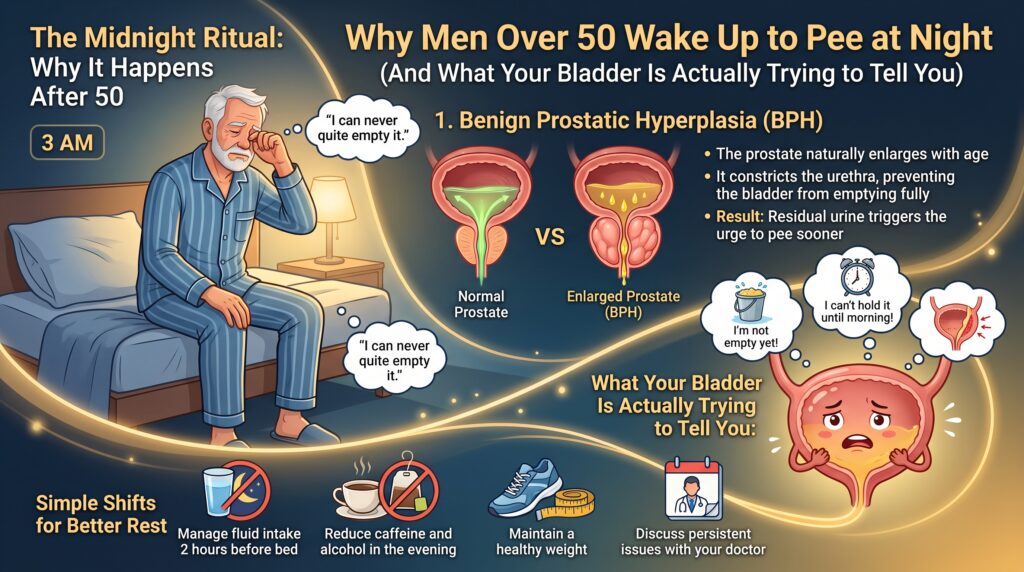
1. An Enlarged Prostate (BPH)
The prostate gland sits directly beneath the bladder and wraps around the urethra. As men age, prostate tissue naturally proliferates in response to hormonal changes — a process called benign prostatic hyperplasia. As the gland enlarges, it can press against the urethra and obstruct urine flow, which in turn causes the bladder muscles to work harder and empty less completely. A bladder that can’t fully empty during the day will also refuse to hold a full night’s worth of urine — hence the 2 a.m. wake-up call.
Yale Medicine notes that about 50% of men between 51 and 60 have BPH, climbing to 70% of men in their 60s and around 80% of men over 70.
2. Nocturnal Polyuria (Your Kidneys Switch Shifts)
As men age, the body produces less of a hormone called antidiuretic hormone (vasopressin) at night — the hormone that normally concentrates urine while you sleep so you don’t need to void. Without enough of it, your kidneys keep producing urine at daytime rates around the clock. This condition, called nocturnal polyuria, is one of the most under-recognized causes of nighttime waking and can occur even in men with a completely normal prostate.
3. Reduced Bladder Capacity and Overactive Bladder
Bladder storage problems — including reduced bladder capacity and detrusor overactivity — are a leading cause of nocturia independent of urine volume. This often shows up as frequent, small-volume urination, both day and night.
4. Sleep Disorders (Especially Sleep Apnea)
Insomnia, sleep apnea, and other sleep disturbances can contribute to or even cause nocturia. Apnea episodes trigger a stress response that increases urine production and disrupts the hormone signals that normally suppress nighttime voiding. Many men treated for sleep apnea report their nighttime bathroom trips drop dramatically once the apnea itself is managed.
5. Underlying Medical Conditions
Nocturia is also linked to cardiovascular disease, type 2 diabetes, chronic kidney disease, and heart failure — non-urological causes such as heart failure, diabetes, sleep apnea, fluid or alcohol intake, and diuretic or hypnotic medications can all contribute to the number of nighttime voids. This is one of the key reasons doctors don’t dismiss nocturia as “just aging” — it can be an early signal worth screening for.
6. Everyday Habits
- Drinking fluids (especially alcohol or caffeine) within 2–3 hours of bedtime
- Taking diuretic medications (common blood pressure prescriptions) in the evening
- High-sodium dinners, which pull fluid into the bloodstream overnight
“It’s Just Part of Getting Older” — Is That True?
Partially — but that mindset can be costly. Nocturia is common with age, but “common” doesn’t mean “harmless” or “untreatable.” Research increasingly shows that frequent nighttime urination carries real downstream health risks:
- Falls and fractures. Waking up disoriented in the dark and walking to the bathroom is a major, often overlooked, fall risk in older men — one reason geriatric specialists take nocturia seriously in patients over 65.
- Cardiovascular strain. A 2024 clinical study of 246 men referred to a urology clinic found that nocturia severity was significantly associated with stiffer arteries (measured by brachial-ankle pulse wave velocity), a marker linked to future cardiovascular events.
- Chronic sleep deprivation. Fragmented sleep from repeated waking is linked to daytime fatigue, reduced concentration, and even depressive symptoms. A large survey of nocturia patients found decreased quality of life from daytime sleepiness, reduced productivity, and depression among men with two or more nightly episodes.
- Quality of life. Beyond the physical, men frequently describe changes in behavior — avoiding long car trips, hesitating to travel, or feeling anxious about being far from a bathroom.
This is exactly why urologists recommend treating nocturia as a symptom worth investigating, not just a nuisance to tolerate.
A Common Scenario Urologists See Every Week
Primary care physicians and urologists describe a very familiar pattern: a man in his mid-50s who mentions, almost as an afterthought at the end of an annual physical, “Oh — I’ve also been getting up two or three times a night to pee.” He assumes it’s just age. After a simple symptom questionnaire (often the International Prostate Symptom Score, or IPSS), a urinalysis, and sometimes a PSA blood test, the picture usually becomes clear — most often early BPH, sometimes a treatable sleep issue, occasionally an early sign of a metabolic condition like prediabetes.
The point isn’t to alarm you. It’s to illustrate that this symptom is medically informative, easy to evaluate, and often very manageable once identified. There’s nothing embarrassing about raising this topic — nocturia is one of the most common complaints urologists hear in primary care, and there is a clear, well-established pathway for evaluating it.
What You Can Do Tonight
While a proper diagnosis requires a doctor, there are evidence-informed habits that genuinely reduce nighttime trips for many men:
- Shift your fluid intake earlier. Front-load water and other drinks earlier in the day; taper off 2–3 hours before bed.
- Cut evening alcohol and caffeine. Both are diuretics and bladder irritants — even a single evening drink can trigger extra waking.
- Watch your evening sodium. A salty dinner pulls water back into circulation overnight, increasing urine production while you sleep.
- Elevate your legs for an hour before bed. This helps redistribute fluid that pools in the legs during the day (a major contributor to nocturnal polyuria) before you lie down.
- Ask your doctor about medication timing. If you take a diuretic (“water pill”) for blood pressure, ask whether it can be moved to the morning.
- Strengthen your pelvic floor. Targeted exercises can improve bladder control and reduce urgency — see our full breakdown in The Best Exercises for Prostate Health: What Urologists Actually Recommend.
- Get screened for sleep apnea if you snore heavily or wake up gasping — treating apnea often reduces nighttime urination as a side benefit.
When to See a Doctor
Self-care habits can help at the margins, but they don’t replace a proper evaluation — especially since nocturia can overlap with more serious warning signs. You should schedule an appointment if you notice:
- 3 or more nighttime bathroom trips, consistently
- Pain, burning, or blood when urinating
- A weak or interrupted urine stream
- Unexplained weight loss alongside urinary changes
- Difficulty starting urination or a feeling of incomplete emptying
We cover this in detail, including which symptoms are considered urgent, in Prostate Warning Signs After 50: What’s Normal, What’s Not, and When to Act.
A doctor will typically start with a simple symptom questionnaire, a review of your current medications, a urinalysis, and possibly a PSA and glucose panel — a straightforward, non-invasive process that usually points quickly to the underlying cause.
Supporting Prostate Health Long-Term
For men whose nighttime urination is linked to early prostate changes, many take a combined approach: medical guidance, lifestyle adjustments, and in some cases, a targeted prostate-support supplement alongside their doctor’s plan. If you’re researching options in this category, our detailed breakdown of ingredients, expected effects, and real customer feedback may help you evaluate whether it’s worth discussing with your physician: ProstaVive Review 2026: Ingredients, Benefits, Side Effects, and Real Customer Experiences.
(Reminder: supplements are not a substitute for a medical diagnosis, and you should always check with your doctor before starting any new product — especially if you take blood pressure or blood thinning medication.)
Frequently Asked Questions
Is it normal to wake up once a night to pee after 50? Yes. Waking once is generally considered within normal limits for men over 50. Two or more times per night is when it’s classified as nocturia and worth mentioning to a doctor.
Can nocturia be a sign of prostate cancer? Nighttime urination is far more commonly caused by benign prostate enlargement (BPH), not cancer. However, because urinary symptoms can occasionally overlap with more serious conditions, a doctor’s evaluation — including a PSA test when appropriate — is the only way to rule it out with confidence.
Does drinking less water actually help? Reducing fluids specifically in the 2–3 hours before bed can help, but restricting overall daily water intake is not recommended and can cause dehydration, especially in older adults. Timing matters more than total volume.
Can nocturia be reversed or cured? Many underlying causes — BPH, sleep apnea, medication timing, evening fluid habits — are treatable or manageable, which often significantly reduces or resolves nocturia. A formal diagnosis determines which treatment path applies to you.
Is nocturia linked to heart health? Emerging research suggests a connection between frequent nocturia and markers of arterial stiffness, a cardiovascular risk factor, which is one more reason not to dismiss the symptom as purely inconvenient.
The Bottom Line
Waking up to pee at night after 50 is extremely common — but “common” is not the same as “nothing to look into.” It can stem from a range of causes, from a naturally enlarging prostate to sleep apnea to how your kidneys are producing urine while you sleep. The good news: most causes are identifiable with simple tests, and most are manageable with the right combination of lifestyle changes and medical guidance.
If this has become a regular part of your nights, don’t just adjust to it — get it evaluated. Better sleep, and possibly some early insight into your broader health, may be on the other side of one conversation with your doctor.
Related Reading
- ProstaVive Review 2026: Ingredients, Benefits, Side Effects, and Real Customer Experiences
- The Best Exercises for Prostate Health: What Urologists Actually Recommend
- Prostate Warning Signs After 50: What’s Normal, What’s Not, and When to Act
Sources & References
- National Institute of Diabetes and Digestive and Kidney Diseases (NIDDK) — Enlarged Prostate (Benign Prostatic Hyperplasia)
- NCBI StatPearls (NIH) — Nocturia
- NCBI StatPearls (NIH) — Benign Prostatic Hyperplasia
- Yale Medicine — Enlarged Prostate (Benign Prostatic Hyperplasia) Fact Sheet
- American Urological Association Journals — The Prevalence and Causes of Nocturia
- NCBI PMC — Nocturia and Arterial Stiffness / Cardiovascular Risk in Men
- NCBI PMC — Nocturia-Related Quality of Life in Men With LUTS
- Keystone Urology Specialists — Nocturia
Disclaimer: This content is intended for general informational and educational purposes only. It is not medical advice and should not be used to diagnose or treat any health condition. Always consult a qualified healthcare provider regarding any urinary, prostate, or sleep-related symptoms.
Tags: #NocturiaInMen #ProstateHealth #MensHealthOver50 #BPH #NighttimeUrination #SleepHealth #UrologyTips #AgingWell #BladderHealth #EnlargedProstate